May he be a role model so that more people use libraries and develop such a sense of honor.
Hero pilot Chesley (Sully) Sullenberger sweats lost book
by Bill Hutchinson - Daily News
Tuesday, February 3rd 2009, 7:37 PM
He has nerves of steel, but hero pilot Chesley (Sully) Sullenberger is jittery about an overdue library book.
Living up to his squeaky clean image, the US Airways captain has informed his hometown library that he may not be able to return a borrowed book - about ethics, of all things.
The former fighter pilot has a good excuse: The book was lost when he was forced to make a splash landing on the frigid Hudson River last month.
Sullenberger and co-pilot Jeffrey Skiles have been credited with saving themselves and 153 passengers and crew.
Officials at the Danville, Calif., library revealed that the flying ace rang them up saying the book is still in the crashed airliner's cargo hold and could he get an extension and a waiver on overdue fees.
The book had been borrowed from the Fresno State University library.
Peter McDonald, dean of library services at Fresno State, said he was bowled over by Sully's sense of responsibility.
"Clearly this is a wonderful, feel-good story, and we honor Mr. Sullenberger both for what he did on the Hudson and for his quick response to a lost book," McDonald told the Fresno Bee newspaper.
Citing privacy issues, McDonald refused to reveal the book's title and said Sullenberger's name should have been kept confidential.
"But now that the story's broke, we thank him again and we will replace the book in his honor," said McDonald, adding that any overdue fees will be forgiven.
Sullenberger, 58, had just taken off from LaGuardia Airport Jan. 15 when his Airbus jet flew into a flock of birds, causing both engines to conk out.
Unable to make it safely to an emergency landing strip, Sullenberger decided to ditch the plane in the river.
A similar scare happened yesterday in Denver when a United Airlines jet was forced to return to the airport after a bird was sucked into one of its engines on takeoff.
The Boeing 757 landed safely and none of the 151 passengers and crew was injured.
Tuesday, February 10, 2009

Monday, February 9, 2009
Technology in the Library
A patron called looking for the song "Blue Prelude" (found in book entitled Sammy Kaye's musical memories - call number [MUSIC] Q 784 S). Tried faxing it to her, twice, but her number was busy. She called back fifteen minutes later; a problem with her fax machine. Could I fax it to her library, North Bellmore? Of course. When I started to dial the library to alert them, I relalized I did not know her name. So I got on whitepages.com, did a reverse lookup on her number, and got the name Norman Perkins. Then got on Millenium and looked up Norman Perkins; copied his address and looked up the address: two names appeared, Norman and Sonya. Faxed music and a cover sheet, on the latter writing that Mrs. Sonya Perkins would pick up the sheet music. Voila.
Saturday, February 7, 2009
Mean Streets
Home buyers signed a statement saying they would 'not permit the premises to be used or occupied by any person other than members of the Caucasian race.'
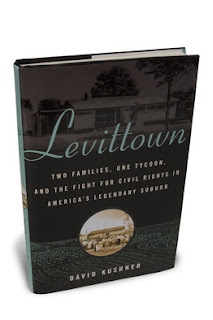
In "Levittown," a vigorous and often surprising narrative, David Kushner journeys into the racially charged heart of what newspapers once trumpeted as "the most perfectly planned community in America." Today Levittown serves as condescending shorthand for suburban conformity. But just after World War II, Levittown, N.Y., and its sister community of Levittown, Pa., symbolized liberation from crowded urban neighborhoods for families whose idea of the American dream was a private home and a patch of grass.
Both Levittowns were conceived from the start as complete communities, themselves prefabricated, so to speak, with shopping centers, churches, pools, parks, curved streets for a rural feel and cul-de-sacs where children could play safely. The Levittown customer, declared Bill Levitt, was "not just buying a house, he's buying a way of life." By 1952, the Levitts were building one out of every eight homes in the country. Time magazine dubbed their company the "General Motors of the housing industry."
But there was a snake in paradise: racial segregation. Buyers of Levittown homes were required to sign a statement that declared, in bold capital letters, that they would "not permit the premises to be used or occupied by any person other than members of the Caucasian race." Like many developers, the Levitts believed that racial integration was commercial suicide.
Mr. Kushner suggests that the demand for housing in the years after the war was so great that the Levitts could have integrated their towns from the start and thus set a national pattern. Instead they capitulated to what they perceived to be Americans' darkest fears. "The plain fact is that most whites prefer not to live in mixed communities," Bill Levitt repeatedly declared.
The core of Mr. Kushner's story focuses on the campaign to desegregate Levittown, Pa., in 1957. He deftly splices together the experiences of two families at the center of what became a terrifying ordeal. Bill and Daisy Myers and their children were educated, friendly, quiet people – just the sort of folks anyone would want to have next-door – except that they were black. Their staunchest local allies were Bea and Lew Wechsler, labor organizers and longtime members of the Communist Party. The Wechslers were among the few whites who remained uncowed by the venomous racism that gripped Levittown that summer.
With the support of local Quakers and the NAACP, the Myerses moved into their Cape Cod-style "dream house" on Deepgreen Lane. They got more than they bargained for. Crosses were burned. Mobs waving Confederate flags staked out their home night and day. Rocks were thrown through their windows. Malicious callers rang their phone around the clock: "I will not let my children drink chocolate milk again as long as I live!" one irate woman yelled at Daisy Myers. Threats were made to burn them out. The local authorities refused to intervene. The police, for the most part, claimed that they were helpless to control the mobs. Many residents in fact blamed the Myerses for provoking all the "agitation."
Books on Charles Darwin
Article by James A. Secord, editor of Evolutionary writings/Including the Autobiographies Charles Darwin
The Tree of Life
By Peter Sís
Farrar, Straus & Giroux, 2003
The Beak of the Finch
By Jonathan Weiner
Knopf, 1994
The Politics of Evolution
By Adrian Desmond
University of Chicago, 1989
Charles Darwin
By Janet Browne
Knopf, 1995, 2002 (two vols.)
Darwin Loves You
By George Levine
Princeton, 2006
The Tree of Life
By Peter Sís
Farrar, Straus & Giroux, 2003
The Beak of the Finch
By Jonathan Weiner
Knopf, 1994
The Politics of Evolution
By Adrian Desmond
University of Chicago, 1989
Charles Darwin
By Janet Browne
Knopf, 1995, 2002 (two vols.)
Darwin Loves You
By George Levine
Princeton, 2006
Friday, February 6, 2009
Abe as He Really Was
Mathew Brady's photograph of Lincoln in February 1860.
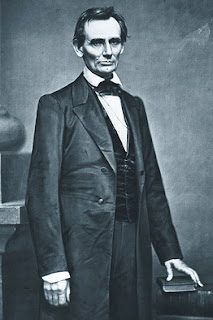
"A. Lincoln" (Random House, 796 pages, $35), by Ronald C. White Jr., is the first comprehensive, single-volume biography of Lincoln since David Herbert Donald's in 1996.
Lincoln's relation to the written word is the subject of Fred Kaplan's "Lincoln: The Biography of a Writer" (Harper, 406 pages, $27.95). Not unlike Allen C. Guelzo, who argued in "Redeemer President" (1999) that Lincoln deserves to be considered a first-rate political thinker, Mr. Kaplan argues that Lincoln deserves to be considered a first-rate American writer.
Lincoln actually knew more than he let on, as Craig L. Symonds, a retired Annapolis professor, notes in his splendid "Lincoln and His Admirals" (Oxford, 430 pages, $27.95). The only president to hold a patent (on a device designed to lift riverboats over shoals), Lincoln was fascinated by maritime technology and frequently visited the Washington Navy Yard to see the latest weapons and engines.
Working at close quarters with Lincoln in the White House was an education in itself, as Daniel Mark Epstein observes in "Lincoln's Men" (Collins, 262 pages, $26.99), his study of Lincoln's secretaries: John Hay, John Nicolay and William Stoddard.
Lincoln in Black and White
A Harvard scholar takes a look at the Great Emancipator


The Wall Street Journal: There have been 14,000 books written about Lincoln, according to you, more than any other American. Isn't that enough?
Mr. Gates: The only person who has received more attention in print is Jesus, which is astonishing. But, no one has done a book or film from my particular perspective.
Yet you grew to like him even more after delving into his racial attitudes, correct?
The difference between Lincoln and everybody else is that he had a capacity to grow. In the last speech of his life, Lincoln said for the first time in the American presidency: "I want to give the right to vote to [a few] black men." He thought the Declaration of Independence included black men. Thomas Jefferson didn't do that.
Barack Obama swore the oath of office on the Lincoln Bible and references Lincoln frequently in speeches.
Barack Obama is the logical extension of Lincoln's decision to abolish slavery in the South and his embrace of black rights at the end of his life. Also, Lincoln was the Great Reconciliator "with malice toward none": That's Barack Obama.
In the film you show "Abraham Obama," a work by street artist Ron English that melds Lincoln and Obama's faces into a single image. Do you think the comparison is appropriate?
When we filmed they gave me a poster. I'm looking forward to having Abraham Obama sign it.


Wednesday, February 4, 2009
Dewey at the Super Bowl
Douglas J. Rowe, AP Entertainment Writer, reviewed NBC's telecast of the Super Bowl. He had kind words for Al Michaels, the announcer and John Michaels, commentator.
Michaels and Madden played off each other as well as ever, too.
When Pittsburgh QB Ben Roethlisberger went over to the sideline trying to decide what play to call, Michaels said:
"He has a 150 to 200 plays on that wristband so maybe they needed some help with the Dewey decimal system to find it."
"Just imagine what the print looks like on that," Madden responded.
"You gotta have Ted Williams' eyesight," Michaels theorized.
Gotta love a football announcer that brings in the Dewey Decimal system.
Saturday, January 31, 2009

Friday, January 30, 2009
Sahara

A Bogart film; pretty much what I expected: minimalist sets, gritty acting, a bit (nay, more) propaganda; fun.
Thursday, January 29, 2009
Why Evolution Is True
 Why Evolution Is True
By Jerry A. Coyne
(Viking, 282 pages, $27.95)
In a couple of weeks, on Feb. 12, biologists the world over will celebrate Charles Darwin's 200th birthday. Throughout the year, at festivals galore marking his bicentennial, "On the Origin of Species," a mere 150 years old, will be hailed as one of the greatest works in the history of the sciences. News of these events is likely to leave many American citizens bemused, possibly even irritated, for, as public-opinion surveys reveal, most of our countrymen have grave doubts about the truth of Darwin's theory. The skeptics are not just rustic provincials, people deprived of serious educational opportunities. Prominent politicians and recent presidents are among them.
That would be one George Walker Bush, surely.
Despite what you might have heard, the mere fact that a majority of Americans would prefer to have Darwinism "balanced" in the biology classroom with "rival theories" is not one of the major tragedies of our time. For thoughtful and accomplished scientists, however, the public's inclination is a sign of a dismal attitude toward science, a blind stubbornness in responding to evidence -- in short, the triumph of prejudice over reason.
How refreshing to read such words: not one of the major tragedies of our time. Too often leftists and liberals and academics make it seem that unless their opinion is heeded the universe will collapse.
Darwinism is thus a claim with several basic components, and the book is structured by carefully exhibiting the evidence for each. Making that structure explicit allows readers to recognize just where they are in the argument. As they follow Mr. Coyne's parade of evidence -- his discussions of the fossil record, of vestigial traits, of the ways in which living things constantly make novel use of the bits and pieces they have inherited, of the distribution of plants and animals -- the components of Darwin's thesis are sequentially supported. We have a list of things to be shown, they are shown and the truth of evolution is established.
Of course, then there is bumper-sticker expression that the faithful simply accept as true: God said it, I believe it, and that settles it.
Wednesday, January 28, 2009
Monarch Migration
PBS program: Alien Empire
Monarch butterflies have one of the world’s most fascinating migration paths. Every fall, thousands of the black-and-orange butterflies fly west to their wintering grounds in California and Mexico, covering the trees there with their bright shimmering wings. The remarkable sight attracts scores of tourists: Pacific Grove, CA, has earned the nickname “Butterfly Town, U.S.A.” for the host of Monarchs that gather there every year. Come spring, the butterflies fly back to their summer homes, where they will lay eggs and die. A typical butterfly will make just one round trip during its lifetime.For centuries, people puzzled over exactly where the millions of Monarchs that spend their winters in Mexico and California came from. But in 1937, a researcher named F. A. Urquhart began putting wing tags on the butterflies, allowing him to track some of the travelers. In the 1950s, he expanded the project, enlisting more than 3,000 volunteers across the country in his Insect Migration Association. For more than 20 years, the volunteers helped track the marked insects, contacting Urquhart whenever they found or saw a marked Monarch.
Monarch butterflies have one of the world’s most fascinating migration paths. Every fall, thousands of the black-and-orange butterflies fly west to their wintering grounds in California

The results of the tracking project astounded many people. One tagged butterfly was tracked along a 1,870-mile route. Originally tagged on September 18, 1957 in Highland Creek, Ontario, it was spotted again in San Luis Potosi, Mexico, four months later. Of course, the butterfly’s actual flight distance was even longer than a map suggests, because the insects don’t fly in a straight line. They must dodge mountains, fight against winds, and flee predators on their perilous journeys.
Today, thousands of people continue to tag monarchs in an effort to study their migration. In 1997, for instance, the research organization Monarch Watch helped volunteers place small sticky wing tags on more than 75,000 butterflies. And in 1998, it distributed more than 200,000 tags to people interested in helping out with the annual tracking project. While the group isn’t sure how many of the 1998 tags actually made it onto butterflies’ wings, at least 35 marked monarchs were spotted at their wintering grounds in Mexico. One had flown at least 1,844 miles southwest from where it was tagged in Campbell, MN, to its roosting spot in El Rosario, Mexico. But some tagged monarchs took off in unexpected directions. One butterfly flew about 550 miles due west from western Kentucky to Lindsborg, KS, where trackers Grant Linder and Hannah Giles spotted it.Tuesday, January 27, 2009
FDR quote
In gathering books for a display) Obama, FDR, Lincoln and ML King)on the main floor of the Library, I researched FDR a bit, and found this great quote.
Some Roosevelt critics in the wealthy business community said he was leading the United States into communism. During the Great Depression he said to his business detractors: "The test of our progress is not whether we add more to the abundance of those who have much; it is whether we provide enough for those who have too little."
Emphasis added.
Monday, January 26, 2009
Praise song for the day.
Elizabeth Alexander's poem for the Inauguration of Barack Obama as POTUS.
Tuesday, January 20, 2009
THE POEM
Praise song for the day.
Each day we go about our business, walking past each other, catching each others' eyes or not, about to speak or speaking. All about us is noise. All about us is noise and bramble, thorn and din, each one of our ancestors on our tongues. Someone is stitching up a hem, darning a hole in a uniform, patching a tire, repairing the things in need of repair.
Someone is trying to make music somewhere with a pair of wooden spoons on an oil drum with cello, boom box, harmonica, voice.
A woman and her son wait for the bus.
A farmer considers the changing sky; A teacher says, "Take out your pencils. Begin."
We encounter each other in words, words spiny or smooth, whispered or declaimed; words to consider, reconsider.
We cross dirt roads and highways that mark the will of someone and then others who said, "I need to see what's on the other side; I know there's something better down the road."
We need to find a place where we are safe; We walk into that which we cannot yet see.
Say it plain, that many have died for this day. Sing the names of the dead who brought us here, who laid the train tracks, raised the bridges, picked the cotton and the lettuce, built brick by brick the glittering edifices they would then keep clean and work inside of.
Praise song for struggle; praise song for the day. Praise song for every hand-lettered sign; The figuring it out at kitchen tables.
Some live by "Love thy neighbor as thy self."
Others by first do no harm, or take no more than you need.
What if the mightiest word is love, love beyond marital, filial, national. Love that casts a widening pool of light. Love with no need to preempt grievance.
In today's sharp sparkle, this winter air, anything can be made, any sentence begun.
On the brink, on the brim, on the cusp -- praise song for walking forward in that light.
Sunday, January 25, 2009
Ladri di biciclette
 Bicycle Thiefs - Vittorio de Sica's 1948 film. A fascinating aspect of it is seeing how poor and devastated Italy was after WW2. In black and white, it has a stark feel, an almost desperate air at times, enhancing its impact. Early on there is a scene where the lead character, Antonio Ricci, leaves his bicycle to be watched by a kid, and the anticipation of its being stolen is palpable. As an aside, I mention that when Ricci returns the kid is nowhere to be seen, though the bicycle is still there.
Saturday, January 24, 2009
Funny Face

Always wonderful to hear Gershwin music. Yet this film tries my credulity: Astaire was 58 when the 1957 movie was released; Audrey Hepburn 28; they were paired romantically, a concept that really does not work all these many years later. 30 year difference; did it ever work? The music is good. Paris look great. Cliches abound: swans and white doves are merely the beginning; berets, smoky clubs, syrupy accents. Still, buy the premise, buy the film. If you analyze it, you ain't gonna enjoy it. Just suspend cynicism. It does work. Audrey Hepburn dancing bebop, beatnik dance; Astaire doing softshoe; they are wonderful. Kay Thompson, an actress I did not know, and an actress who made very few films (four?) does a really nice job.
The Wizard of Tuskegee
 Up From History (excerpt)
By Robert J. Norrell
(Harvard University Press, 508 pages, $35)
After decades of neglect, Booker T. Washington is the subject of a timely reappraisal
A century ago, the most consequential black person in America was a biracial man who had been abandoned by his father and raised by his mother, and who favored a nonconfrontational style of politics. Sound familiar?
Eerily so. Booker T. Washington was seen as a sort of Uncle Tom in times when radicalism and defiance were the orthodoxies. But ...
Washington went on to advise four U.S. presidents and he dined at the White House with fellow Republican Theodore Roosevelt, a black first. His 1901 autobiography, "Up From Slavery," was translated into seven languages and became the best-selling book ever written by a black. Andrew Carnegie called him the second father of the country. Many of America's other moneyed men, including John D. Rockefeller and J.P. Morgan, were admirers and major benefactors. Harvard and Dartmouth gave him honorary degrees. Mark Twain and William Dean Howells sang his praises, the latter calling him "a public man second to no other American in importance."
Must recall that TR was an heir to Lincoln; Republicans both. Progressives. Democrats had bee Copperheads, Dixiecrats. As for B.T. Washington, there was more, much more.
For two generations after his death, Booker T. Washington remained widely appreciated. Numerous schools, parks, streets and black-owned businesses were named in Washington's honor. He was the first black to have his likeness appear on a U.S. postage stamp and commemorative coin. In 1942, a Liberty ship was christened the Booker T. Washington. And in 1956, marking the 100th anniversary of Washington's birth, President Dwight Eisenhower created a national monument to the former slave.
Think: in 1942 the Army was segregated, and a ship was named for Washington. But then came the protests.
But Washington's star began to dim in the 1960s, when the style of civil-rights advocacy was given over to protest, condemning authority and challenging the status quo at every turn. The thrust of Washington's message was self-improvement. His focus was the development of the black population of the rural South. His unwillingness to practice protest politics, however, has earned him the scorn of many modern-day critics, who dismiss him as too meek in his dealings with whites.
Why couldn't he be respected, and built on? Ideologic orthodoxies require conformity to the party line.
In "Up From History," a compelling biography, Robert J. Norrell restores the Wizard of Tuskegee to his rightful place in the black pantheon. Just as important, Mr. Norrell explains how ideological imperatives can cloud clear thinking, even among historians who should know better.
Mr. Norrell, a history professor at the University of Tennessee, says that this "present-mindedness of historians writing about race" is a function of the fact that many had themselves been activists and admired the accomplishments of civil-rights protest. "A presumption entered the thinking and writing that protest was correct," he writes, "and for most the only legitimate, means of improving minority conditions. By the mid-1960s Washington was understood to have been the enemy of activism, the Uncle Tom who delayed the day of freedom."
Victory by Longbow
 Agincourt
By Bernard Cornwell
(Harper, 451 pages, $27.99)
Reviewed by Ron Maxwell
Mr. Maxwell has written a cinematic trilogy on Joan of Arc titled "The Virgin Warrior." He wrote and directed the motion pictures "Gettysburg" and "Gods & Generals." His Web site can be found at www.ronmaxwell.com.

Thursday, January 22, 2009
Film: The Earl of Chicago


It worked, barely; and beside learning that Robert Montgomery was not only a Republican but a friendly witness before witch-hunting anti-Communist committees, it's okay. Barely. Saw it on TCM.
Subscribe to:
Posts (Atom)

