Students starting school this year may be part of the last generation for which "going to college" means packing up, getting a dorm room and listening to tenured professors. Undergraduate education is on the verge of a radical reordering. Colleges, like newspapers, will be torn apart by new ways of sharing information enabled by the Internet. The business model that sustained private U.S. colleges cannot survive.
Change is unstoppable, of course. And technology is changing virtually everything.
The real force for change is the market: Online classes are just cheaper to produce. Community colleges and for-profit education entrepreneurs are already experimenting with dorm-free, commute-free options. Distance-learning technology will keep improving. Innovators have yet to tap the potential of the aggregator to change the way students earn a degree, making the education business today look like the news biz circa 1999. And as major universities offer some core courses online, we'll see a cultural shift toward acceptance of what is still, in some circles, a "University of Phoenix" joke.
One element is missing from this model: interaction between people. In coming years virtual interaction will be possible as technology improves, but the interaction between live people can not be replicated.
This doesn't just mean a different way of learning: The funding of academic research, the culture of the academy and the institution of tenure are all threatened.
Online degrees are already relatively inexpensive. And the price will only dive in coming decades, as more universities compete.
Of course, a cultural shift will be required before employers greet online degrees without skepticism. But all the elements are in place for that shift. Major universities are teaching a few of their courses online. And the young students of tomorrow will be growing up in an on-demand, personalized world, in which the notion of a set-term, offline, prepackaged education will seem anachronistic.
Not all colleges will be similarly affected. Like the New York Times, the elite schools play a unique role in our society, and so they can probably persist with elements of their old revenue model longer than their lesser-known competitors. Schools with state funding will be as immune as their budgets. But within the next 40 years, the majority of brick-and-mortar universities will probably find partnerships with other kinds of services, or close their doors.
Even the Times is in trouble.
So how should we think about this? Students who would never have had access to great courses or minds are already able to find learning online that was unimaginable in the last century. But unless we make a strong commitment to even greater funding of higher education, the institutions that have allowed for academic freedom, communal learning, unpressured research and intellectual risk-taking are themselves at risk.
If the mainstream of "college teaching" becomes a set of atomistic, underpaid adjuncts, we'll lose a precious academic tradition that is not easily replaced.
Thursday, September 17, 2009

Tuesday, September 8, 2009
A reputation made, and ...
Once popular, an author has a built-in audience. Witness Dan Brown, whose Da Vinci Code made his name: his new book, The Lost Symbol, has 231 holds in the large print version, and 688 on the regular-type version.
Equally, Pat Conroy's new book, South of Broad, has 569 holds on first copy returned of 203 copies. Nicholas Sparks is also an established favorite; his latest, The Last Song, has 390 holds on first copy returned of 57 copies.
Publishing thrives, perhaps even survives, on this phenomenon: guaranteed readers.
*
In contrast, consider this book:
 The study of counterpoint from Johann Joseph Fux's Gradus ad parnassum ; translated and edited by Alfred Mann, with the collaboration of John Edmunds. New York : W.W. Norton, 1971. [Call No. 781.42 F]
It has circulated once.
Wednesday, September 2, 2009
Monday, August 31, 2009
Books on Political Conspiracy
1. It Can't Happen Here. Sinclair Lewis. Doubleday, 1935
A charismatic Democratic senator who speaks in "noble but slippery abstractions" is elected president, in a groundswell of cultish adoration, by a nation on the brink of economic disaster. Promising to restore America's greatness, he promptly announces a government seizure of the big banks and insurance companies. He strong-arms the Congress into amending the Constitution to give him unlimited emergency powers. He throws his enemies into concentration camps. With scarcely any resistance, the country has become a fascist dictatorship. No black helicopters here, though. Sinclair Lewis's dystopian political satire, now largely forgotten except for its ironic title, was a mammoth best seller in 1935, during the depths of the Depression and the rise of fascism in Europe. His president, Berzelius ("Buzz") Windrip, is a ruthless phony with the "earthy sense of humor of a Mark Twain"; one of the few who dare oppose him openly is a rural newspaper editor who is forced to go on the run. Lewis's prose could be ungainly, but he captured with caustic humor the bumptious narrow- mindedness of small-town life.
2. The Ministry of Fear. Graham Greene. Viking, 1943
Set in London during the Blitz, "The Ministry of Fear"—the only novel Graham Greene wrote during the war years—opens with a now-familiar Hitchcockian gambit: An innocent man stumbles upon a secret and is marked for death. Arthur Rowe, a loner who has just been released from an insane asylum, wins a cake at a carnival by guessing its precise weight. Concealed in the cake is a spool of film intended for a Nazi spy. Rowe becomes the target of a  shadowy international espionage ring bent on stealing vital British war plans. On this slim armature Greene constructs a richly atmospheric thriller, one of the classics of the genre. His prose is spare and elegant, his pacing masterly. The protagonist, haunted by a terrible crime in his past, loses his memory and comes to feel "directed, controlled, molded, by some agency with a surrealist imagination," pursued through a city where entire buildings can disappear overnight in a bombing raid.
Also made into a film starring Ray Milland and Marjorie Reynolds.
3. Libra. Don DeLillo. Viking, 1988
Don DeLillo, our poet of paranoia, here reimagines the assassination of John F. Kennedy. It's a conspiracy theory about conspiracy theories, about the powerful mythology of the greatest crime of the American century. DeLillo's language is dazzling as he presents an ingenious fusing of fact and fiction, theory and reality. A CIA operative devises an "electrifying event" that will force the invasion of Cuba. He enlists a pawn, Lee Harvey Oswald, to unwittingly carry out a "spectacular miss." But of course a perfect plan conceived by "men in small rooms" must self-destruct in the cold light of reality. This is a hallucinatory meditation on the seductiveness of conspiracy: strangely lyrical and fraught with steadily encroaching terror. Oswald, the puppet, is no more paranoid than his masters; the difference is that they realize that there is always "a world inside the world."
4. Advise and Consent. Allen Drury. Doubleday, 1959
A generation of political junkies got hooked on the ways of Washington because of this book, published 50 years ago. The winner of the Pulitzer Prize for fiction, "Advise and Consent" revealed the inner workings of the Senate—and offered compelling drama along the way. An ailing, manipulative, FDR-like president nominates as secretary of state an arrogant liberal intellectual and would-be Soviet appeaser, meant to evoke Alger Hiss. In the midst of his vicious confirmation battle, evidence emerges that he was once a member of a secret Communist cell. Allen Drury, who was a reporter in the New York Times's Washington bureau, is not exactly subtle about his politics: All of his bad guys are soft on Communism. The capital he depicts is a period piece: Senators all orate like William Jennings Bryan; socialite hostesses have boozy salons where senators get sloppy; a hint in a newspaper column can destroy a politician's career. But it's addictive reading and arguably still the best novel about Washington politics.
Made into a film with Henry Fonda, Charles Laughton, Don Murray, Walter Pidgeon, Peter Lawford, Gene Tierney, Franchot Tone, Lew Ayres, Burgess Meredith, Eddie Hodges.
5. The Matarese Circle. Robert Ludlum. Bantam, 1979
No one will ever call Robert Ludlum a great novelist or even a good writer of prose. But "The Matarese Circle," his best thriller, perfectly captured the paranoid suspicions of post-Watergate America. In Ludlum's cosmology, it's always a few brave individuals up against immense and yet somehow still unseen conspiracies. An ancient secret society of assassins-for-hire has been revived by a powerful organization that turns out to be controlling entire governments. Only two men can save the world: one a rogue agent in the CIA, the other in the KGB—sworn enemies forced to work together. Eventually they uncover a sinister plot involving a Kennedy-like family and an impostor who is on the verge of being elected to the White House. There is a classic scene in which our hero discovers who is in on the conspiracy and it turns out to be . . . everyone.
—Mr. Finder, a member of the Association of Former Intelligence Officers, is the author of nine novels, including "Paranoia" and "High Crimes." His suspense thriller "Vanished" has just been published by St. Martin's Press.
A charismatic Democratic senator who speaks in "noble but slippery abstractions" is elected president, in a groundswell of cultish adoration, by a nation on the brink of economic disaster. Promising to restore America's greatness, he promptly announces a government seizure of the big banks and insurance companies. He strong-arms the Congress into amending the Constitution to give him unlimited emergency powers. He throws his enemies into concentration camps. With scarcely any resistance, the country has become a fascist dictatorship. No black helicopters here, though. Sinclair Lewis's dystopian political satire, now largely forgotten except for its ironic title, was a mammoth best seller in 1935, during the depths of the Depression and the rise of fascism in Europe. His president, Berzelius ("Buzz") Windrip, is a ruthless phony with the "earthy sense of humor of a Mark Twain"; one of the few who dare oppose him openly is a rural newspaper editor who is forced to go on the run. Lewis's prose could be ungainly, but he captured with caustic humor the bumptious narrow- mindedness of small-town life.
2. The Ministry of Fear. Graham Greene. Viking, 1943
Set in London during the Blitz, "The Ministry of Fear"—the only novel Graham Greene wrote during the war years—opens with a now-familiar Hitchcockian gambit: An innocent man stumbles upon a secret and is marked for death. Arthur Rowe, a loner who has just been released from an insane asylum, wins a cake at a carnival by guessing its precise weight. Concealed in the cake is a spool of film intended for a Nazi spy. Rowe becomes the target of a
 shadowy international espionage ring bent on stealing vital British war plans. On this slim armature Greene constructs a richly atmospheric thriller, one of the classics of the genre. His prose is spare and elegant, his pacing masterly. The protagonist, haunted by a terrible crime in his past, loses his memory and comes to feel "directed, controlled, molded, by some agency with a surrealist imagination," pursued through a city where entire buildings can disappear overnight in a bombing raid.
Also made into a film starring Ray Milland and Marjorie Reynolds.
3. Libra. Don DeLillo. Viking, 1988
Don DeLillo, our poet of paranoia, here reimagines the assassination of John F. Kennedy. It's a conspiracy theory about conspiracy theories, about the powerful mythology of the greatest crime of the American century. DeLillo's language is dazzling as he presents an ingenious fusing of fact and fiction, theory and reality. A CIA operative devises an "electrifying event" that will force the invasion of Cuba. He enlists a pawn, Lee Harvey Oswald, to unwittingly carry out a "spectacular miss." But of course a perfect plan conceived by "men in small rooms" must self-destruct in the cold light of reality. This is a hallucinatory meditation on the seductiveness of conspiracy: strangely lyrical and fraught with steadily encroaching terror. Oswald, the puppet, is no more paranoid than his masters; the difference is that they realize that there is always "a world inside the world."
4. Advise and Consent. Allen Drury. Doubleday, 1959
A generation of political junkies got hooked on the ways of Washington because of this book, published 50 years ago. The winner of the Pulitzer Prize for fiction, "Advise and Consent" revealed the inner workings of the Senate—and offered compelling drama along the way. An ailing, manipulative, FDR-like president nominates as secretary of state an arrogant liberal intellectual
 and would-be Soviet appeaser, meant to evoke Alger Hiss. In the midst of his vicious confirmation battle, evidence emerges that he was once a member of a secret Communist cell. Allen Drury, who was a reporter in the New York Times's Washington bureau, is not exactly subtle about his politics: All of his bad guys are soft on Communism. The capital he depicts is a period piece: Senators all orate like William Jennings Bryan; socialite hostesses have boozy salons where senators get sloppy; a hint in a newspaper column can destroy a politician's career. But it's addictive reading and arguably still the best novel about Washington politics.
Made into a film with Henry Fonda, Charles Laughton, Don Murray, Walter Pidgeon, Peter Lawford, Gene Tierney, Franchot Tone, Lew Ayres, Burgess Meredith, Eddie Hodges.
5. The Matarese Circle. Robert Ludlum. Bantam, 1979
No one will ever call Robert Ludlum a great novelist or even a good writer of prose. But "The Matarese Circle," his best thriller, perfectly captured the paranoid suspicions of post-Watergate America. In Ludlum's cosmology, it's always a few brave individuals up against immense and yet somehow still unseen conspiracies. An ancient secret society of assassins-for-hire has been revived by a powerful organization that turns out to be controlling entire governments. Only two men can save the world: one a rogue agent in the CIA, the other in the KGB—sworn enemies forced to work together. Eventually they uncover a sinister plot involving a Kennedy-like family and an impostor who is on the verge of being elected to the White House. There is a classic scene in which our hero discovers who is in on the conspiracy and it turns out to be . . . everyone.
—Mr. Finder, a member of the Association of Former Intelligence Officers, is the author of nine novels, including "Paranoia" and "High Crimes." His suspense thriller "Vanished" has just been published by St. Martin's Press.
The Torching of Atlanta
A Currier and Ives depiction of Union troops as they took Atlanta on Sept. 2, 1864.


Bonds, Russell S. (2009). War Like the Thunderbolt : The Battle and Burning of Atlanta. Westholme Pub Llc 2009

Wortman, Marc. (2009). The bonfire: the siege and burning of Atlanta. New York: PublicAffairs.


Bonds, Russell S. (2009). War Like the Thunderbolt : The Battle and Burning of Atlanta. Westholme Pub Llc 2009

Wortman, Marc. (2009). The bonfire: the siege and burning of Atlanta. New York: PublicAffairs.
Friday, August 28, 2009
a taste of Paine
 Who was Paine? Depending on whom you ask, he was either an uncompromising free-thinker who made possible the popular embrace of the Declaration of Independence, or "a filthy little atheist," as Teddy Roosevelt once described him. A seditious subject of the English crown or an honorary French citizen chucked in the Bastille. Or just a fiercely American idealist with too much interest in brandy and democracy and not enough in fashion or personal hygiene.
The painting, a bust circa 1792 by Laurent Dabos of Toulouse, seems to have been lost until only a few years ago, when it surfaced in England. It's a flattering portrait, but—not surprisingly, perhaps—on the back of the canvas an anonymous hand appears to have scribbled something of an insult to Paine.
Thursday, August 27, 2009
Keen Eye, Staccato Brush
 Slideshow
As he traveled through Italy, the painter focused on details of place, recording with bold strokes not only characteristic buildings or how the distinctive ruddy, lozenge-shaped sails of Venetian fishing boats punctuate an expanse of blue water, but also such specifics as the way Venetian women drape their shawls. His eye was equally acute for qualities of light, as he conjured up the subtleties of changing seasons, times of day and weather with a nuanced palette. In "Prendergast in Italy," the moist gray radiance of early spring in the Mediterranean is suggested in watercolors made during a trip south to escape the cold and damp of a Venetian winter, but mostly the sun shines, skies are dazzlingly blue, flags stir in gentle breezes and water sparkles in detached patterns of light and dark.
Even rain elicits delicious images. A shower provides shimmering reflections in the wet pavement of the Piazza San Marco: the basilica's complex façade, with its rows of stacked columns, lunettes and glittering mosaics, fuses with the figures milling in front of the splendid doors. A more determinedly rainy day offers an excuse to translate water and pavement, gondolas, and pedestrians huddled under black umbrellas into a tasty orchestration of beiges, grays and cool gray-blue. But we see far more parasols than umbrellas in Prendergast's Venice, bold spots of color that form a cheerful, tossing canopy above the throngs swarming over the arched bridges, all of it turned into rapid touches of unmodulated hues distilled from the sunlight reflected from the canals.
In my experience, Mexico offers as beautiful a landscape and rich an architectural heritage as Italy, but it has nothing to equal Venice. What country does? As far as I know, Venice is unique.
The fine selection in "Prendergast in Italy" draws upon the large collection given to Williams by the widow of the artist's brother and that of the show's joint organizer, the Chicago-based Terra Foundation for American Art. What's perhaps most remarkable about the exhibited works is that no matter how familiar or potentially "touristic" Prendergast's subjects, his images are never predictable or trite. However much a view of the Grand Canal resonates with our own experience of Venice, it engages us most deeply as a painting. "Prendergast in Italy" is worth a detour, as the Michelin guides say.
Williams College Museum of Art
Wednesday, August 26, 2009
New chapter in E-Book Readers
Sony Corp., hoping to steal some of Amazon.com Inc.'s thunder in the electronic-book market, unveiled a wireless reader that could be the strongest competitor to Amazon's Kindle this holiday season.
Priced at $399, the Sony Reader Daily Edition is $100 more expensive than the entry-level Kindle, but one-ups the market leader with a touch-sensitive screen and access to books from a range of sources, including libraries. Kindle users are largely limited to books from Amazon's online store.
Sony disclosed Tuesday a marketing partnership with Cleveland-based OverDrive Inc. that will let users of Sony's wireless device enter their Zip Codes and library card number to see what e-books are available from their local library; they can then download e-books remotely to the device until the loans expire.
Tuesday, August 25, 2009
Try not to gloat
 Surely, obviously, clearly, librarians will be among the many that will be, some openly, many covertly, gloating, saying, perhaps just thinking, I told you so.
Yet, let not sanctimony be thy refuge.
Wikipedia, one of the 10 most popular sites on the Web, was founded about eight years ago as a long-shot experiment to create a free encyclopedia from the contributions of volunteers, all with the power to edit, and presumably improve, the content.
Now, as the English-language version of Wikipedia has just surpassed three million articles, that freewheeling ethos is about to be curbed.
Officials at the Wikimedia Foundation, the nonprofit in San Francisco that governs Wikipedia, say that within weeks, the English-language Wikipedia will begin imposing a layer of editorial review on articles about living people.
The new feature, called “flagged revisions,” will require that an experienced volunteer editor for Wikipedia sign off on any change made by the public before it can go live. Until the change is approved — or in Wikispeak, flagged — it will sit invisibly on Wikipedia’s servers, and visitors will be directed to the earlier version.
The change is part of a growing realization on the part of Wikipedia’s leaders that as the site grows more influential, they must transform its embrace-the-chaos culture into something more mature and dependable.
It is popular, and often the first result in a search. But ...
Although Wikipedia has prevented anonymous users from creating new articles for several years now, the new flagging system crosses a psychological Rubicon. It will divide Wikipedia’s contributors into two classes — experienced, trusted editors, and everyone else — altering Wikipedia’s implicit notion that everyone has an equal right to edit entries.
And for seven months beginning in November, The New York Times worked with Wikipedia administrators to suppress information about the kidnapping of David Rohde, a correspondent in Afghanistan, from the article about him. The Times argued that the censorship would improve his chances of survival. Mr. Rohde escaped from his Taliban captors in June, but the episode dismayed some Wikipedia contributors.
Who perhaps might have said, had he not escaped, or had his head been cut off, that it was the bad guys that did the horrible deed, not them.
The Writer and His Refuge

Mr. Conroy is famous for having mined his own life and that of his family for material from which to craft his earlier novels "The Great Santini," "The Lords of Discipline," "The Prince of Tides" and "Beach Music." Readers—or moviegoers who've seen the films based on the books—know of his constant uprooting because of his father's career as a fighter pilot; his changing feelings about his alma mater, the Citadel; his earlier marriages; his time in Paris and Rome; and—thanks to his cookbook/memoir—his appreciation of food. But I've asked to speak with both Mr. Conroy and Ms. King because I want them to tell me about their time writing in Highlands, N.C., my hometown, and maybe reclaim a little of Mr. Conroy's fame for the Tar Heel State. After all, he lived in both Belmont and New Bern for periods during his youth, and he's been a fan of Thomas Wolfe since his junior year of high school, when his English teacher gave him a copy of "Look Homeward, Angel," then drove him to Asheville to retrace Wolfe's footsteps.
Monday, August 24, 2009
Excuse me?
"Do you work here?" she asked, in a barely audible from across the Information Desk, where I sat, behind the front of the desk, waiting to help the next person who came along.
Startled, I pondered that for a moment. I'm sitting at the Desk, the computer screen in front of me. Well, perhaps it wasn't obvious, though it did seem so to me.
"Yes, I do," I answered.
"Can you help me?" she asked. "Over here." She stood by one of the OPAC computers.
I walked over dutifully.
She wanted to print out a list of items, but I advised her that wasn't possible, as OPACs don't have attached printers. Adding, helpfully, I told her she could print from an Internet PC, but would need to provide her own paper (or buy some at Circulation).
That deterred her. Buy, her thoughts were almost visible; me, buy? "Can I get a piece of paper, so I can write down some information?" she countered.
"Sure," I answered, and gave her the scratch paper.
"No, that won't be big enough."
"Well, there are plenty of them," I added helpfully.
"No, that won't do," she insisted. "Can I have just one sheet of paper? How much is one sheet of paper?"
"We do not sell single sheets of paper." I eventually gave her one sheet, and she was content. So was I.
Wednesday, August 12, 2009
Polite Debate at Grassley's Iowa Town Halls
Not all town-hall meetings are raucous. And some take place in libraries.
Back home for his first set of public events since Congress left its recess, Grassley has packed his town halls, which he holds in the same locations every year, more than ever. When he showed up in Winterset on Wednesday morning, his aides had already moved the event from a meeting room in the library to a nearby park, as a crowd that would normally be about 70 was instead several hundred. In Afton, an event that had been planned at the city hall was moved to a Methodist church nearby, and even then people were standing outside the door trying to hear the longtime senator.
And note this exchange:
Iowans just might be less eager to yell and be rude. When one man in Afton asked Grassley why he was eager to change a health-care system that many Americans like, the senator started referring to a private conservation he had with a Democratic senator on Capitol Hill.
"Which one?" the man shouted.
"I can't tell you that," Grassley said.
"Why not?" the man snapped back.
"Because it was a private conservation," Grassley responded.
"Oh, okay," the man said, and let the senator finish.
Imagine acceptin gthe keeping of confidentiality.
Books on Drinking
A well-stocked library will include these books on the pleasures and hazards of drink, says Iain Gately
1. Under the Volcano. Malcolm Lowry. Penguin, 1947. FIC Lowry
Malcolm Lowry wrote of this novel: “The dream I cherished in my heart was to create a pioneer work . . . and to write at last an authentic drunkard’s story.” He succeeded—it is amusing, poignant and macabre. Lowry sobered up to write the book, which is set in a provincial Mexican town during its annual festival celebrating the dead. The story describes the last days of Geoffrey Firmin, a British diplomat who had been posted to this backwater so that he can kill himself, with mescal, discreetly. “Under the Volcano” offers vivid descriptions of what it feels like to be under the influence, including the dubious pleasure of vomiting in your neighbor’s garden and the shame of being incontinent and legless. Moreover, the novel shows great literary merit as Lowry plays with our sense of time, intercutting flashbacks and black-outs in stream-of-semiconsciousness. Above all, Lowry is a sympathetic observer of humanity, sober or not.
2. Prohibition. Andrew Sinclair. Little, Brown, 1962 973.9 S
I like my history dry. “Prohibition: The Era of Excess” documents, with an appropriate degree of cynicism, America’s flirtation with enforced sobriety. The champions of abstinence were frauds or megalomaniacs; the politicians they blackmailed to amend the Constitution without a vote were equally amoral; and the gangsters who profited from keeping Americans wet pushed the murder rate back to frontier-era levels. National Prohibition lasted from 1919 to 1932, encompassing the Roaring ’20s, the Great Depression and the birth of the modern age. The book is as much testament to the changes that occurred during that period as to the failure of the “noble experiment.” There is a supporting cast of fanatics, lunatics and thieves and final salvation via the intercession of a president promising a new deal. A master of his material, Andrew Sinclair also has an eye for pleasing ephemera, such as this bumper sticker from Michigan in 1929: “Don’t shoot—I’m not a bootlegger.”
3. Vintage. Hugh Johnson. Simon & Schuster, 1989 641.2209 J
“Vintage” is an excellent reference work on “the story of wine,” distinguished by its genial style and the evident affection of its author for his subject. In addition to charting how our passion for wine has influenced the ebb and flow of civilizations, the book is packed with esoterica, including the taste and price of Falernian red in ancient Pompeii and the menus of Parisian restaurants during the Franco-Prussian war (roast cat garlanded with rats, served with Bollinger champagne). Essential for anyone wishing to know how champagne got its fizz or how claret evolved from the generic name for a pink, sour fluid into the Premier Crus of Bordeaux.
4. Gin. Patrick Dillon. Charles Justin, 2003 363.41 D
In the early 1700s, London was the largest, most dissolute and most exciting city in Europe. People flocked to it from the provinces, inspired by the pantomime of Dick Whittington and his Cat and the rumor that its streets were paved with gold. The king, William of Orange, had come to power in the Glorious Revolution, after sailing over from Holland, the “home of spirits.” He owed his throne to a cabal of landowners and merchants who were suffering from a fall in the price of grain, and he placated them by giving anyone in England the right to distill gin, or Geneva, as it was called, in an approximation of the Dutch word for the juniper berries used as flavoring. Demand soared for grain and gin, which was distilled in basements and sold from shops, houses, the crypts of churches, boats, wheelbarrows and stalls at public executions. In “Gin,” Patrick Dillon sets the scene and details the fall-out of the West’s first spirits craze with charm and a degree of relish. For roughly half a century, until Parliament finally reined in the gin-distilling business, the death rate in London exceeded the birth rate. The city swarmed with “scandalous wretches” (as one Londoner put it) who “ran up and down the streets swearing, cursing and talking beastliness like so many devils” because of “this damn’d bewitching liquor.” While documenting the carnage, Dillon makes space for the sea change in public opinion that enabled Parliament to slay the monster it had created. The book is an outstanding example of how narrative nonfiction can bring an era and its concerns back to life.
5. Headlong Hall. Thomas Love Peacock. 1816. FIC Peacock
The Enlightenment collides with the squirearchy in this Regency novel set in a Welsh manor over Christmas. Guests argue over “Progress” or its absence, and their host, Harry Headlong, moderates their debates with claret, port, brandy and aqua vitae. There are skulls, explosions, landscaped gardens, the Peacock-coined word osseocarnisanguineoviscericartilaginonervomedullary (the bony fleshy bloody gutsy gristly marrowy totality of the body), a ball and later betrothals—all lubricated with lashings of booze. “Headlong Hall” is also a roman à clef featuring Samuel Taylor Coleridge and other Romantic poets, drawn from life. Best of all, it is an enthusiastic and stylish picture of the joys of commensal drinking.
—Mr. Gately is the author of “Drink: A Cultural History of Alcohol,” published in paperback by Gotham.
Books and films asked for today
That old cape magic. Russo, Richard. 123 holds on first copy returned of 72 copies.
Bride wars [videorecording (DVD)]
Shanghai girls. See, Lisa.
Loving Frank. Horan, Nancy.
Stomp out loud [videorecording (DVD)] / a YES/NO Production.
Such sweet thunder; forty-nine pieces on jazz. : Balliett, Whitney.
Elsa & Fred. Film from Spain.
Raising a child with soul. Jungreis-Wolff, Slovie.
The defector. Silva, Daniel. 599 holds, 213 copies; 26 more on order (18 by Hewlett)
Gertrude Lawrence as Mrs. A; an intimate biography of the great star. Aldrich, Richard Stoddard. no holds on 3 copies; an unusual request, saying the least.
Act like a lady, think like a man. Harvey, Steve. 39 holds on first copy returned of 118 copies
Rules of vengeance. Reich, Christopher.
Knowing [videorecording (DVD)]
Gran Torino [videorecording (DVD)]
Northanger Abbey. Austen, Jane.An unusual one; I have never heard of it.
U.S. Bares ‘Alien Files’ Kept on Immigrants
Adele Macher, researching her Italian roots.

Immigration files containing a wealth of information collected by American border agents, some of it dating from the late 19th century, will be opened to the public soon and permanently preserved, providing intriguing nuggets about such famous immigrants or visitors as Alfred Hitchcock and Salvador Dalí.
But to millions of Americans, the real treasure will be clues about their own families’ histories in the photographs, letters, interrogation transcripts and recordings that reflect the intense scrutiny faced by those trying to enter the United States during an era when it waged two world wars and adopted increasingly restrictive immigration policies.
Under an agreement signed this year, the files, on some 53 million people, will be gradually turned over by the Department of Homeland Security to the National Archives and Records Administration, beginning in 2010. The material, accounting for what officials describe as the largest addition of individual immigration records in the archives’ history, will be indexed and made available to anyone.
Ms. Macher used the Freedom of Information Act to obtain a copy of the Alien File kept on her great-aunt Laura D’Amario.

Wednesday, August 5, 2009
Note to Myself: Take the Kitchen
When cooking in a vacation rental, the author has been known to travel with supplies, but this June she had a revelation: one needs only a cast-iron skillet to survive.

Article by one of my favorite writers, and with a mention of a librarian.
The house, midcentury modern in design, was once the year-round residence of a painter and his wife. The wife had been a librarian, and the kitchen was a curated archive of faintly antiquated but classic equipment: oblong Pyrex bakers, a spindly, nonergonomic can opener, an electric hand mixer with all its parts laid out in a pullout drawer, against the shelving paper. The crockery was without pattern, in neutral shades of bone and brown and black, and the coffee cups were on the small side. Even on vacation, it took me three or four refills to face the day.

Hold that book
2 books, actually:
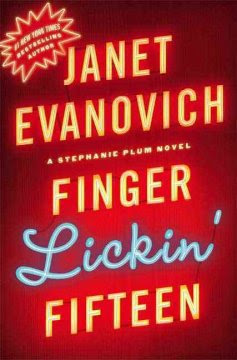 Evanovich, Janet. (2006). Finger lickin' fifteen. New York: St. Martin's Press.
231 holds on first copy returned of 263 copies
 Weiner, Jennifer.(2009). Best friends forever. New York : Atria Books.
548 holds on first copy returned of 172 copies
 Evanovich, Janet. (2006). Finger lickin' fifteen. New York: St. Martin's Press.
231 holds on first copy returned of 263 copies
 Weiner, Jennifer.(2009). Best friends forever. New York : Atria Books.
548 holds on first copy returned of 172 copies
Wednesday, July 29, 2009
Author Without Borders
The writer William T. Vollmann at the Terrace Park Cemetery in Holtville, Calif., a burial place for illegal immigrants who have died crossing the border.

More Photos >
William T. Vollmann, legendarily prolific, writes in a studio that used to be a restaurant in Sacramento. The place is surrounded by a big parking lot where he encourages homeless people to camp out. Inside he runs a one-man assembly line. His bibliography so far includes nine novels, including “Europe Central,” which won the National Book Award in 2005; three collections of stories; a seven-volume, 3,000-page history of violence; a book-length essay on poverty; and a travel book about hopping freight trains, a hobby of his even though his balance is so bad that he has to use a plastic bucket as a stepstool.
Mr. Vollmann’s newest book, “Imperial,” which comes out from the Viking Press on Thursday, costs $55 and is 1,300 pages long — so heavy, he observed recently, that if you dropped it, you’d break a toe. A companion volume, to be published next month by powerHouse Books, contains some 200 photographs he took while working on “Imperial,” for which he also wore a spy camera while trying to infiltrate a Mexican factory, and paddled in an inflatable raft down the New River in California, a rancid trench that is probably the most polluted stream in America. The water, he writes, tasted like the Salk polio vaccine.
Mr. Vollmann, who just turned 50, is a loner, a bit of a recluse, despite being married and the father of a daughter, and a throwback: a wandering, try-anything writer-journalist in the tradition of Steinbeck or Jack London. Some people think he’s a little nuts.
A little?
To research “The Rifles,” a novel partly about the 1845 Franklin expedition to the Arctic, Mr. Vollmann spent two weeks alone at the magnetic North Pole, where he suffered frostbite and permanently burned off his eyebrows when he accidentally set his sleeping bag on fire. But being eyebrowless has its advantages, he discovered more recently, while experimenting with cross-dressing to research a novel he’s now writing about the transgendered. He didn’t have to pluck his brows when getting made up.
Well, that's an advantage.
 Slide Show
A Drive Through ‘Imperial’
“Imperial,” which is about Imperial County in California, the vast, flat and arid region in the southeastern part of the state, bordering Mexico, is an extreme Vollmann production: brilliant in places, practically unreadable in others. There are lyrical passages, and others edging over into magenta (“And change came; just as the urine of dehydrated people is turbid and dark, failing in transparency, so the evening sunlight, as if heated to exhaustion by and with itself, now lost the glaring whiteness which had characterized it since early morning, and it oozed down upon the pavement to stain it with gold”), along with scientific chapters, complete with graphs, on salinization and agricultural productivity, and 175 pages of notes. A page early on has a title warning of “Impending Aridity.”
Phew! Exhausting just reading this paragraph.
The book is a little like the Imperial Valley itself: pathless, fascinating, exhausting. Its two great themes are illegal immigration — the struggle of countless thousands of Mexicans to sneak into the United States through the Imperial Valley — and water, which has transformed the valley, or parts of it, from desert to seeming paradise but at great environmental cost.
Mr. Vollmann’s editors urged him to cut, he said, and he resisted: “We always go round and round. They want me to cut, and I argue, so they cut my royalties, and I agree never to write a long book again.” He acknowledged that the length of “Imperial” might cost him readers but said: “I don’t care. It seems like the important thing in life is pleasing ourselves. The world doesn’t owe me a living, and if the world doesn’t want to buy my books, that’s my problem.”
Good point.
On a cloudless, sun-baked day last week Mr. Vollmann, with a characteristically bad haircut, toured some of the landscapes that had inspired him, traveling from San Diego across the border to the Mexican town of Tecate, down the mountainous, hairpin road to Mexicali and then back across the border into California, through the Imperial Valley to the Salton Sea, an enormous inland lake that is the region’s agricultural sink, so hyper-saline from irrigation runoff that it is almost toxic.
Along the way, some of the secrets of Mr. Vollmann’s method began to reveal themselves. Mr. Vollmann doesn’t drive, and his Spanish is only so-so, so he was driven, as he was for most of the 12 years it took him to write the book, by Terrie Petree, who also served as an interpreter. She learned her Spanish as a Mormon missionary in northern Spain, which also prepared her, she said, for having doors shut in her face. Mr. Vollmann sat in the passenger seat, taking in everything and peppering Ms. Petree with questions. Far from manic, he was preternaturally calm and patient, dosing himself with nothing stronger than bottled water.
Being a passenger certainly allows him to observe everything. I remember that feeling when we rode the bus from Guadalajara to Melaque: I could see everything at my leisure.
Mr. Vollmann is almost excessively polite, and in conversation has a salesman’s habit of using your first name in every other sentence. He seems more innocent than worldly, driven by insatiable curiosity. In Mexicali he turned an annoying and time-consuming visit to a police station, occasioned by what appeared to be a traffic-fine shakedown, into an interview with the station’s chief of information. He also charmed a blushing secretary there and learned the name of the best taco joint in town.
And he speak Spanish poorly.

More Photos >
William T. Vollmann, legendarily prolific, writes in a studio that used to be a restaurant in Sacramento. The place is surrounded by a big parking lot where he encourages homeless people to camp out. Inside he runs a one-man assembly line. His bibliography so far includes nine novels, including “Europe Central,” which won the National Book Award in 2005; three collections of stories; a seven-volume, 3,000-page history of violence; a book-length essay on poverty; and a travel book about hopping freight trains, a hobby of his even though his balance is so bad that he has to use a plastic bucket as a stepstool.
Mr. Vollmann’s newest book, “Imperial,” which comes out from the Viking Press on Thursday, costs $55 and is 1,300 pages long — so heavy, he observed recently, that if you dropped it, you’d break a toe. A companion volume, to be published next month by powerHouse Books, contains some 200 photographs he took while working on “Imperial,” for which he also wore a spy camera while trying to infiltrate a Mexican factory, and paddled in an inflatable raft down the New River in California, a rancid trench that is probably the most polluted stream in America. The water, he writes, tasted like the Salk polio vaccine.
Mr. Vollmann, who just turned 50, is a loner, a bit of a recluse, despite being married and the father of a daughter, and a throwback: a wandering, try-anything writer-journalist in the tradition of Steinbeck or Jack London. Some people think he’s a little nuts.
A little?
To research “The Rifles,” a novel partly about the 1845 Franklin expedition to the Arctic, Mr. Vollmann spent two weeks alone at the magnetic North Pole, where he suffered frostbite and permanently burned off his eyebrows when he accidentally set his sleeping bag on fire. But being eyebrowless has its advantages, he discovered more recently, while experimenting with cross-dressing to research a novel he’s now writing about the transgendered. He didn’t have to pluck his brows when getting made up.
Well, that's an advantage.
Slide Show A Drive Through ‘Imperial’
“Imperial,” which is about Imperial County in California, the vast, flat and arid region in the southeastern part of the state, bordering Mexico, is an extreme Vollmann production: brilliant in places, practically unreadable in others. There are lyrical passages, and others edging over into magenta (“And change came; just as the urine of dehydrated people is turbid and dark, failing in transparency, so the evening sunlight, as if heated to exhaustion by and with itself, now lost the glaring whiteness which had characterized it since early morning, and it oozed down upon the pavement to stain it with gold”), along with scientific chapters, complete with graphs, on salinization and agricultural productivity, and 175 pages of notes. A page early on has a title warning of “Impending Aridity.”
Phew! Exhausting just reading this paragraph.
The book is a little like the Imperial Valley itself: pathless, fascinating, exhausting. Its two great themes are illegal immigration — the struggle of countless thousands of Mexicans to sneak into the United States through the Imperial Valley — and water, which has transformed the valley, or parts of it, from desert to seeming paradise but at great environmental cost.
Mr. Vollmann’s editors urged him to cut, he said, and he resisted: “We always go round and round. They want me to cut, and I argue, so they cut my royalties, and I agree never to write a long book again.” He acknowledged that the length of “Imperial” might cost him readers but said: “I don’t care. It seems like the important thing in life is pleasing ourselves. The world doesn’t owe me a living, and if the world doesn’t want to buy my books, that’s my problem.”
Good point.
On a cloudless, sun-baked day last week Mr. Vollmann, with a characteristically bad haircut, toured some of the landscapes that had inspired him, traveling from San Diego across the border to the Mexican town of Tecate, down the mountainous, hairpin road to Mexicali and then back across the border into California, through the Imperial Valley to the Salton Sea, an enormous inland lake that is the region’s agricultural sink, so hyper-saline from irrigation runoff that it is almost toxic.
Along the way, some of the secrets of Mr. Vollmann’s method began to reveal themselves. Mr. Vollmann doesn’t drive, and his Spanish is only so-so, so he was driven, as he was for most of the 12 years it took him to write the book, by Terrie Petree, who also served as an interpreter. She learned her Spanish as a Mormon missionary in northern Spain, which also prepared her, she said, for having doors shut in her face. Mr. Vollmann sat in the passenger seat, taking in everything and peppering Ms. Petree with questions. Far from manic, he was preternaturally calm and patient, dosing himself with nothing stronger than bottled water.
Being a passenger certainly allows him to observe everything. I remember that feeling when we rode the bus from Guadalajara to Melaque: I could see everything at my leisure.
Mr. Vollmann is almost excessively polite, and in conversation has a salesman’s habit of using your first name in every other sentence. He seems more innocent than worldly, driven by insatiable curiosity. In Mexicali he turned an annoying and time-consuming visit to a police station, occasioned by what appeared to be a traffic-fine shakedown, into an interview with the station’s chief of information. He also charmed a blushing secretary there and learned the name of the best taco joint in town.
And he speak Spanish poorly.
Monday, July 27, 2009

Wednesday, July 22, 2009
Target Can Make Sleepy Titles Into Best Sellers
At Target, Bookmarked book club titles get stickers, left, and special shelves, above. Almost one-third of the sales of “Still Alice,” by Lisa Genova, can be traced to Target.

When “Sarah’s Key,” a novel about an American journalist investigating the 1942 roundup of Jews in Paris, was published in hardcover two years ago, it dropped with a thud. According to Nielsen BookScan, which tracks about 70 percent of sales, the book sold just 2,000 copies.
Indeed, the book, by the first-time novelist Tatiana de Rosnay, was well on its way to sinking out of sight last fall when Target, the discount retailer, chose the paperback version of “Sarah’s Key” as its Bookmarked Club Pick: a choice for a program that designates titles for prominent display throughout the chain’s stores. Suddenly sales exploded.

In publishing circles Target has long been known as a place that can move many copies of discounted best sellers, as do other mass-merchant retailers like Wal-Mart and Costco. But in the last few years, much in the way it has cultivated its image as a counterintuitive purveyor of Isaac Mizrahi clothes or Michael Graves tea kettles, Target has been building itself into a tastemaker for books.
Through its book club, as well as a program it calls Bookmarked Breakout, both started in 2005, the company has highlighted largely unknown writers, helping their books find their way into shopping carts filled with paper towels, cereal and shampoo.
Target “can sell hundreds of thousands of copies of a book that is virtually unknown in the rest of the marketplace,” said Jacqueline Updike, director of adult sales at Random House, one of the world’s largest publishers.
By assembling a collection of books by unheralded authors, Target behaves more like an independent bookstore than like a mere retailer of mainstream must-haves (although, of course, Target sells its share of best-seller list regulars, like James Patterson and Janet Evanovich).
Target began its Bookmarked Club Pick and Breakout programs partly to convert “Target core guests into regular Target book shoppers,” said Jana O’Leary, a spokeswoman, in e-mailed responses to questions. Ms. O’Leary said that Target’s “core” book buyers were women, with a median age of 42 and median annual household income of $60,000. About half have completed college degrees, and some have children at home.
The books for both programs are chosen by a panel of Target employees who meet monthly to review submissions from publishers.
In a letter written for the Target edition of “The Wednesday Sisters,” Ms. Clayton connected Target with her main characters: “As women with relationships and jobs to tend to, dinners to cook, miles to run, and children to raise, where else would they go for sweatshirts, cookie pans and the alarm clocks that wake them up so they can write in the early-morning silence, before life intrudes?”
In an interview Ms. Clayton said she was more likely to go to Target herself for “teapots and toasters” and mainly bought books at local independents. Target, she figured, would expand the more typical audience for her novel. “Your book is being seen by people who aren’t necessarily there to buy books,” she said. “It makes you think that walk-by traffic is still selling books.”
Ms. de Rosnay, the author of “Sarah’s Key,” who lives in France, said she knew her paperback had a chance of much bigger sales when a friend sent her an iPhone photo of a shelf full of copies of her book at a Target. “That’s when I realized this was big — really big,” Ms. de Rosnay said.
Tuesday, July 21, 2009
Yiddish: NYC’s 2nd Political Language
In 1922, Fiorello H. La Guardia was re-elected to Congress after he rebutted charges of anti-Semitism by challenging a rival to debate in Yiddish. La Guardia was fluent in Yiddish. His Jewish rival was not.

July 21, 2009
Yiddish Resurfaces as City’s 2nd Political Language
By SAM ROBERTS
In 1897, Isaac Fromme, an office-seeker from the largely Jewish Lower East Side, punctuated his campaign palaver with Yiddishisms to refute insinuations that he was Irish. In 1922, Fiorello H. La Guardia was re-elected to Congress from East Harlem after he rebutted charges of anti-Semitism by challenging a rival to debate in Yiddish. La Guardia, a son of Jewish and Italian parents, was fluent in Yiddish. His Jewish rival was not.
That Yiddish remains the second language of New York politics was demonstrated yet again over the weekend in the disembodied debate between Mayor Michael R. Bloomberg and the State Senate.
On Friday, Mr. Bloomberg said that for the Senate to adjourn for the summer without voting to extend his control over New York City’s school system was “meshugeneh.”
To which State Senator Hiram Monserrate replied on Sunday: “We believe it would be meshugeneh not to include parents in the education of our children. As opposed to loosely using the word ‘meshugeneh,’ we would also say we don’t need a yenta on the other side of this argument and this debate.”
Neither Mr. Monserrate, who is Hispanic, nor Mr. Bloomberg, who is Jewish, was surgically precise with his Yiddishism.
But their casual embrace of an onomatopoetic language is a reminder of how universal Yiddish has become. Not only in New York, where Jews now constitute fewer than one in five mayoral election voters, but even beyond. Meshuga and yenta both appear in the Oxford English Dictionary.
The last Jewish mayor, Edward I. Koch, suggested as much on Monday when he offered an obvious reason why New York politicians drift into Yiddish. “They all want to sound like citizens of the world,” Mr. Koch said.
The comedian Jackie Mason said Mr. Bloomberg would have felt more self-conscious about using Yiddish 10 or 15 years ago. “It’s now hip to be Jewish,” he said. “A Jew used to be embarrassed at saying a Jewish word.”
Twenty years ago, Mr. Mason himself regretted being quoted as describing David N. Dinkins, the Democratic mayoral candidate, as “a fancy schvartze,” invoking a Yiddish word, often used derogatorily, for a black man. Mr. Mason later apologized. “I’m a comedian,” he said then, “not a politician.” He was criticized for calling President Obama the same word during a show this year, but told the entertainment Web site tmz.com that it was no longer a pejorative term.
In 1998, Senator Alfonse M. D’Amato referred to his Democratic opponent, Charles E. Schumer, as a “putzhead.” The backlash to Mr. D’Amato’s reference resonated because of his own reputation for crudity and because he at first denied using the slur.
“I think that Mayor Bloomberg probably used Yiddish as a way of having his kugel and eating it, too,” said Michael Wex, the author of “Born to Kvetch” and “Just Say Nu.”
“His use of meshugeneh — a not uncommon solecism, incidentally; the adverb should be meshuga — seems intended to strengthen his point at the same time as it gives his expression of it a heartfelt, rather than denunciatory, feel,” Mr. Wex said. “The idea that ‘this is crazy, pure and simple’ comes across all the more strongly by implying that English simply lacks the words to describe what he’s feeling — that in his guts, as they used to say, he knows it’s nuts.
“Rather than crossing ethnic lines here, Mayor Bloomberg seems to be presenting himself as an Everyman who, since he happens to be Jewish, expresses himself in the idiom that’s supposed to be closest to his heart,” Mr. Wex said.
“Senator Monserrate raises the stakes, though, by calling the mayor a yenta —‘a female motormouth,’ ” Mr. Wex continued. “If the senator’s earlier uses of meshugeneh were meant to show that he could play the mayor’s game, yenta is his way of proving that he can even play it better.”
Whatever the mayor’s motivation in resorting to Yiddish, the debate with some of the Democratic senators, who want to loosen mayoral control of the schools, was degenerating well beyond meshugas into a very English digression. When Mr. Bloomberg invoked Neville Chamberlain on Friday in defending his version of mayoral control over education against any compromise, was he suggesting that the senators were comparable to Adolf Hitler?
“It wasn’t an analogy at all — the mayor was talking about endless negotiations in general,” Stu Loeser, Mr. Bloomberg’s chief spokesman, explained on Monday. “The former prime minister’s name is now synonymous in the American lexicon with appeasement and endless negotiations. Since it wasn’t an analogy, the mayor wasn’t comparing anyone to anyone else.”
Gordon Waller, of Peter and Gordon
July 21, 2009
Gordon Waller, a Partner in the Band Peter and Gordon, Dies at 64
By DOUGLAS MARTIN
Gordon Waller, who formed half of Peter and Gordon, a successful pop duo that followed the Beatles to America as part of the British Invasion of the 1960s and that scored a No. 1 hit with “A World Without Love,” died on Friday in Norwich, Conn. He was 64 and lived in Ledyard, Conn.
His death was announced on the official Peter and Gordon Web site, peterandgordon.net. It gave the cause as cardiac arrest.
Mr. Waller and Peter Asher played acoustic guitars and brought vocal harmonies reminiscent of the Everly Brothers to their own synthesis of folk, blues and rock ’n’ roll. An important ingredient in their success was a steady supply of songs written by Paul McCartney that the Beatles themselves did not record.
By October 1963, Mr. McCartney was dating Mr. Asher’s sister, the actress Jane Asher, and Peter and Gordon had signed a record contract with EMI. They turned to Mr. McCartney to provide a song for them. Knowing he was writing “A World Without Love,” they asked him to finish it for them so they could record it.
The tune became a Top 10 hit in Britain, where it displaced the Beatles’ own “Can’t Buy Me Love” on the charts. It was then issued on the Capitol label in the United States, where it became one of the most successful singles of 1964.
The song, a lilting, plaintive ballad, opens with the lyrics, “Please lock me away/And don’t allow the day/Here inside, where I hide with my loneliness/I don’t care what they say, I won’t stay/In a world without love.”
Peter and Gordon toured the United States and appeared on “The Ed Sullivan Show” and other network variety shows — part of a wave of British groups that swept the United States, among them Chad and Jeremy, the Dave Clark Five and Herman’s Hermits.
Two more McCartney songs that year brought Peter and Gordon even more success: “Nobody I Know” and “I Don’t Want to See You Again.” (Though Mr. McCartney has been widely cited as having written all these songs, he shared credit with John Lennon, their practice at the time.)
Another hit for the duo was Mr. McCartney’s “Woman” (1966), which he wrote under the pseudonym Bernard Webb to see if he could score a hit without the Lennon-McCartney names attached.
Peter and Gordon toured with the Beatles and other big-name groups, like the Rolling Stones. They had at least nine hits, including Del Shannon’s “I Go to Pieces,” the Buddy Holly song “True Love Ways,” “Lady Godiva” and “Knight in Rusty Armor,” all from the mid-60s.
Gordon Trueman Riviere Waller was born in Braemar, Scotland, on June 4, 1945. He attended the Westminster School in London, where he met Mr. Asher. Of the two, Mr. Waller had the greater interest in rock ’n’ roll at first, and he converted Mr. Asher from “a snooty jazz fan to a true rock ’n’ roll believer as well,” Mr. Asher said in a statement.
The boys got guitars and were soon violating the school’s 9 p.m. curfew by sneaking out to play in coffeehouses and nightclubs. That involved climbing a 12-foot-high, spike-topped wall. They were originally known as Gordon and Peter.
“I am just a harmony guy and Gordon was the heart and soul of our duo,” Mr. Asher wrote.
By late 1967, the hits were no longer coming, and both singers were enjoying the work less, Mr. Asher said in a recent interview with classicbands.com. They split in 1968. Mr. Asher went on to manage stars like James Taylor and produce records, while Mr. Waller tried singing as a solo act.
In the 1970s, Mr. Waller played the part of Pharaoh in the musical “Joseph and the Amazing Technicolor Dreamcoat” in productions in London and Australia, and released a solo album titled “and Gordon.” He later ran a music publishing business.
In recent years, Mr. Waller and Mr. Asher reunited to perform occasionally as Peter and Gordon.
Mr. Waller is survived by his wife, Jen, whom he married in 2008, and two daughters from an earlier marriage, The Guardian in London reported.
`
Jupiter, and the Moon
A large impact mark on Jupiter’s south polar region captured on Monday by NASA’s Infrared Telescope Facility in Mauna Kea, Hawaii.

40 years ago yesterday, men walked on the moon. Mission to the Moon
One of several images of the impact mark on Jupiter — the dark spot at the upper right of this photograph — taken by the man who discovered it.

July 21, 2009, 8:59 am
Amateur Finds New Earth-Sized Blot on Jupiter
By Robert Mackey
NASA/JPL, via Associated Press A large impact mark on Jupiter’s south polar region captured on Monday by NASA’s Infrared Telescope Facility in Mauna Kea, Hawaii.
NASA has confirmed the discovery of a new hole the size of the Earth in Jupiter’s atmosphere, apparently showing that the planet was hit by something large in recent days. The impact mark was first spotted on Monday morning by an amateur astronomer in Australia, who then drew the attention of scientists at NASA’s Jet Propulsion Laboratory to the dark mark on Jupiter’s south polar region.
The apparent impact comes almost exactly 15 years after a comet named Shoemaker-Levy 9 struck Jupiter, “sending up blazing fireballs and churning the Jovian atmosphere into dark storms, one of them as large as Earth,” as The New York Times reported on July 19, 1994.
Images of the impact mark, as seen through a NASA telescope in Hawaii, were posted on the space agency’s Web site on Monday with this explanation:
Following up on a tip by an amateur astronomer, Anthony Wesley of Australia, that a new dark “scar” had suddenly appeared on Jupiter, this morning between 3 and 9 a.m. PDT (6 a.m. and noon EDT) scientists at NASA’s Jet Propulsion Laboratory in Pasadena, Calif., using NASA’s Infrared Telescope Facility at the summit of Mauna Kea, Hawaii, gathered evidence indicating an impact.
New infrared images show the likely impact point was near the south polar region, with a visibly dark “scar” and bright upwelling particles in the upper atmosphere detected in near-infrared wavelengths.
Glenn Orton, a scientist at the Jet Propulsion Laboratory, said “It could be the impact of a comet, but we don’t know for sure yet.”
Mr. Orton told New Scientist magazine that the planet could have been hit by a block of ice or a comet that was too faint for astronomers to detect before the impact. Leigh Fletcher, an astronomer at the Jet Propulsion Lab told the magazine the impact scar “is about the size of the Earth.”
In Australia, the Sydney Morning Herald reported that the amateur astronomer, Anthony Wesley, a 44-year-old computer programmer from a village north of Canberra, made the discovery “using his backyard 14.5-inch reflecting telescope.” The Herald explained: “Wesley, who has been keen on astronomy since he was a child, said telescopes and other astronomy equipment were so inexpensive now that the hobby had become a viable pastime for just about anybody. His own equipment cost about $10,000.”
Mr. Wesley recorded the discovery of the impact mark, and posted several of the first images he took of it, in an observation report he posted online:
Anthony Wesley One of several images of the impact mark on Jupiter — the dark spot at the upper right of this photograph — taken by the man who discovered it.
I came back to the scope at about 12:40am I noticed a dark spot rotating into view in Jupiters south polar region started to get curious. When first seen close to the limb (and in poor conditions) it was only a vaguely dark spot, I thought likely to be just a normal dark polar storm. However as it rotated further into view, and the conditions improved I suddenly realised that it wasn’t just dark, it was black in all channels, meaning it was truly a black spot.
My next thought was that it must be either a dark moon (like Callisto) or a moon shadow, but it was in the wrong place and the wrong size. Also I’d noticed it was moving too slow to be a moon or shadow. As far as I could see it was rotating in sync with a nearby white oval storm that I was very familiar with - this could only mean that the back feature was at the cloud level and not a projected shadow from a moon. I started to get excited.
It took another 15 minutes to really believe that I was seeing something new - I’d imaged that exact region only 2 days earlier and checking back to that image showed no sign of any anomalous black spot.
Now I was caught between a rock and a hard place - I wanted to keep imaging but also I was aware of the importance of alerting others to this possible new event. Could it actually be an impact mark on Jupiter? I had no real idea, and the odds on that happening were so small as to be laughable, but I was really struggling to see any other possibility given the location of the mark. If it really was an impact mark then I had to start telling people, and quickly.
The Guardian reports that Mr. Wesley, who “spends about 20 hours a week on his passion of watching and photographing Jupiter,” almost missed making the discovery because he interrupted his work late on Sunday night to watch sports on television. Mr. Wesley told The Guardian:
I was imaging Jupiter until about midnight and seriously thought about packing up and going back to the house to watch the golf and the cricket. In the end I decided to just take a break and I went back to the house to watch Tom Watson almost make history.
I came back down half an hour later and I could see this black mark had turned into view.
In another interview, Mr. Wesley told the Sydney Morning Herald that spotting the impact mark on Jupiter made him glad the huge planet is in Earth’s neighborhood: “If anything like that had hit the Earth it would have been curtains for us, so we can feel very happy that Jupiter is doing its vacuum-cleaner job and hoovering up all these large pieces before they come for us.”
Wednesday, July 15, 2009
Times Co. Agrees to Sell WQXR Radio
The New York Times Company will sell WQXR-FM to WNYC Radio and Univision, the companies announced on Tuesday, in a complex deal that preserves WQXR as the only station devoted solely to classical music in New York City, but that could alter its character.
WQXR would move to a weaker signal near the high end of the FM band, and would become a listener-supported station, owned by WNYC, the nation’s largest public radio station. The Times Company, which has been trying to shed assets to raise cash and weather a newspaper industry downturn, would get $45 million, but would sever ties with a station it has owned since 1944.
The long-rumored sale of WQXR, at 96.3 on the dial, and the real possibility that such a move would spell the death of a major classical music purveyor on the airwaves, was a depressing thought for fans. Classical music radio stations have been dwindling in recent decades.
Talk of the sale also sent shivers through cultural institutions that rely heavily on WQXR, like the New York Philharmonic, the Metropolitan Opera and the Juilliard School.
Heck, there's no full-time jazz station in New York City, either.
Tuesday, July 14, 2009
Rewriting history, Texas style
The fight over school curriculum in Texas, recently focused on biology, has entered a new arena, with a brewing debate over how much faith belongs in American history classrooms. The Texas Board of Education, which recently approved new science standards that made room for creationist critiques of evolution, is revising the state's social studies curriculum. In early recommendations from outside experts appointed by the board, a divide has opened over how central religious theology should be to the teaching of history.
Extending their reach, creationism creeps into history.
Three reviewers, appointed by social conservatives, have recommended revamping the K-12 curriculum to emphasize the roles of the Bible, the Christian faith and the civic virtue of religion in the study of American history. Two of them want to remove or de-emphasize references to several historical figures who have become liberal icons, such as César Chávez and Thurgood Marshall.
Liberal icons? They happen to be accomplished Americans, and also Americans of color. Coincidence the creationists want to "de-emphasize"?
"We're in an all-out moral and spiritual civil war for the soul of America, and the record of American history is right at the heart of it," said Rev. Peter Marshall, a Christian minister and one of the reviewers appointed by the conservative camp.
Well, the Rev is right, but for the wrong reasons. The record of American history includes the accomplishments of Cesar Chávez and Justice Marshall.
The three reviewers appointed by the moderate and liberal board members are all professors of history or education at Texas universities, including Mr. de la Teja, a former state historian. The reviewers appointed by conservatives include two who run conservative Christian organizations: David Barton, founder of WallBuilders, a group that promotes America's Christian heritage; and Rev. Marshall, who preaches that Watergate, the Vietnam War and Hurricane Katrina were God's judgments on the nation's sexual immorality. The third is Daniel Dreisbach, a professor of public affairs at American University.
Elmer Gantry, er, the Revattributes Watergate to sexual immorality? Was Nixon sexually immoral? Or simply immoral?
Hmm, let's see: a former state historian, chairman of the history department at Texas State University, versus a reverend who attributes a neocolonial war to sexual immorality; whom to side with? Who might be more knowledgable? Tough call.
The conservative reviewers say they believe that children must learn that America's founding principles are biblical. For instance, they say the separation of powers set forth in the Constitution stems from a scriptural understanding of man's fall and inherent sinfulness, or "radical depravity," which means he can be governed only by an intricate system of checks and balances.
Through his wickedness, man invented a constitutional system of government; interesting theory. Perhaps instead of Justice Scalia's 'originalist' theory, wherein he tries to deduce what the Revolutionary Generation of Jefferson and Washington and Madison meant, or would have meant, were they to evaluate modern questions and contemporary problems, we should have a fire-and-brimstone Supreme Court where the wicked are exhorted to repent.
Some outside observers argue that curriculum analysts should be trained academics. "It's important to have trained historians establishing the framework," said David Vigilante, associate director of the National Center for History in the Schools at the University of California, Los Angeles.
Good point, but he's from California. Suspected pointy-headed academic liberal.
The conservative Christian reviewers, in turn, are skeptical of the professional historians' emphasis on multiculturalism, views stated most forcefully by Mr. de la Teja but echoed by Ms. Hodges. Reaching for examples of achievement by different racial and ethnic groups is divisive, Mr. Barton said, and distorts history.
Divisive? Right. So their suggestion is to study the white Christian version of history, and unite everyone behind it. Brilliant.
Bells, Saffron and Elephant
Monday was the last day of a five-day ceremony reconsecrating the Ganesha Temple in Flushing, Queens.

More Photos >
As priests poured holy water on the sacred statues, the faithful rushed to catch drops. The temple honors Ganesha, the elephant-faced deity.


More Photos >
As priests poured holy water on the sacred statues, the faithful rushed to catch drops. The temple honors Ganesha, the elephant-faced deity.

The Baite
A patron came in seeking interpretations (Spark Notes, she said, were fine) of John Donne's poem "The Baite." There were books of his poems at 811 Donne, and critcisms at 823 and 828 Donne. Herewith, the poem:
 The Baite
- COME live with mee, and bee my love,
- And wee will some new pleasures prove
- Of golden sands, and christall brookes:
- With silken lines, and silver hookes.
- There will the river whispering runne
- Warm'd by thy eyes, more then the Sunne.
- And there the'inamor'd fish will stay,
- Begging themselves they may betray.
- When thou wilt swimme in that live bath,
- Each fish, which every channell hath,
- Will amorously to thee swimme,
- Gladder to catch thee, then thou him.
- If thou, to be so seene, beest loath,
- By Sunne, or Moone, thou darknest both,
- And if my selfe have leave to see,
- I need not their light, having thee.
- Let others freeze with angling reeds,
- And cut their legges, with shells and weeds,
- Or treacherously poore fish beset,
- With strangling snare, or windowie net:
- Let coarse bold hands, from slimy nest
- The bedded fish in banks out-wrest,
- Or curious traitors, sleavesilke flies
- Bewitch poore fishes wandring eyes.
- For thee, thou needst no such deceit,
- For thou thy selfe art thine owne bait;
- That fish, that is not chatch'd thereby,
- Alas, is wiser farre then I.
- John Donne
Online Software Catch Up
Google Inc.'s plans for a new operating system based on its Chrome Web browser is a big bet that online programs can eventually surpass desktop software. Now the Internet giant is pushing hard to make that happen, enticing developers to take advantage of several technologies to improve the speed, esthetics and reliability of software running in a Web browser.
Google is trying to spur a new market for software that can run entirely in a Web browser, such as Google Docs. The search giant believes that online applications will be one of its next big businesses, as its core search and search-advertising businesses mature.
But it faces heavy competition, including from rival Microsoft Corp., which Monday announced it will offer online versions of its popular Office software to consumers free.
About time.
Google hopes to change that by accelerating the adoption of HTML 5, the acronym for an extension of the hypertext markup language that is a foundation of the Web. The proposed programming standards -- which are likely years from being finalized, and include technology from Google and others -- are designed to let developers build more advanced applications that can run within a browser.
Indeed; plugins should be a thing of the past.
Google and other backers of HTML 5 believe that over time, plug-ins won't be necessary as browsers become more powerful. A Microsoft spokeswoman said the latest version of the company's Internet Explorer browser already supports some elements of HTML 5 and that Microsoft is also a member of the working group responsible for pushing the standard along.
Saturday, July 11, 2009
Guess what?
Man comes up to Information Desk and asks for these books:
The madonnas of Leningrad, Debra Dean.
The pleasures and sorrows of work, Alain de Botton.
Glenn Beck's common sense: the case against an out-of-control government, inspired by Thomas Paine.
The last best hope: restoring conservatism and America's promise, Joe Scarborough.
Then he asked for a newspaper; guess which one? (Hint: Rupert Murdoch; extra hint: not the Wall Street Journal.)
Thursday, June 25, 2009
A reference question
Finally, a question with substance, not for the location of the bathroom or for a paper clip or a telephone number.
A student needing to write a comparison between CS Lewis's The lion, the witch and the wardrobe and L. Frank Baum's The Wizard of Oz. I directed him to the volumes Twentieth Century Literary Criticism and of Contemporary Literary Criticism. I also showed him how to search for the topics in the OPAC:
Baum, L. Frank (Lyman Frank), 1856-1919 -- Criticism and interpretation. : Moore, Raylyn.
Lewis, C. S. (Clive Staples), 1898-1963 -- Criticism and interpretation. (4 entries; 1 by Harold Bloom, whom I praised and recommended.)
The land of Narnia : Brian Sibley explores the world of C.S. Lewis A children's book, a type that can often be helpful even for adults.
Wednesday, June 24, 2009
Cheney to Publish His Memoir
Former Vice President Dick Cheney is working on a book.

The deal was negotiated by Robert Barnett, a Washington lawyer who also represents Mr. Bush, former President Bill Clinton and President Obama.
Is there any better proof of what C. Wright Mills called the Power Elite?

The deal was negotiated by Robert Barnett, a Washington lawyer who also represents Mr. Bush, former President Bill Clinton and President Obama.
Is there any better proof of what C. Wright Mills called the Power Elite?
Friday, June 19, 2009
A Literary Legend Fights for a Library
Ray Bradbury, the author, loves libraries and is helping to save them.
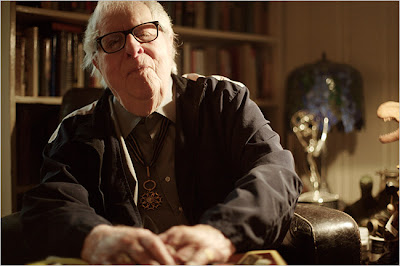
When you are pushing 90, have written scores of famous novels, short stories and screenplays, and have fulfilled the goal of taking a simulated ride to Mars, what’s left?
“Bo Derek is a really good friend of mine and I’d like to spend more time with her,” said Ray Bradbury, peering up from behind an old television tray in his living room.
An unlikely answer, but Mr. Bradbury, the science fiction writer, is very specific in his eccentric list of interests, and his pursuit of them in his advancing age and state of relative immobility.
This is a lucky thing for the Ventura County Public Libraries. Because among Mr. Bradbury’s passions, none burn quite as hot as his life-long passion for halls of books. His most famous novel, “Fahrenheit 451,” which concerns book burning, was written on a pay typewriter in the basement of the University of California, Los Angeles, library; his novel “Something Wicked This Way Comes” contains a seminal library scene.
Mr. Bradbury frequently speaks at libraries across the state, and on Saturday he will make his way here for a benefit for the H. P. Wright Library, which like many in the state’s public system is in danger of shutting its doors because of budget cuts.
One of the great ironies is that during the economic downturn more people than usually have turned to libraries for resources, for a haven, and for direction, and because of the same economic downturn, libraries are suffering budget cuts. and more.
“Libraries raised me,” Mr. Bradbury said. “I don’t believe in colleges and universities. I believe in libraries because most students don’t have any money. When I graduated from high school, it was during the Depression and we had no money. I couldn’t go to college, so I went to the library three days a week for 10 years.”
When he is not raising money for libraries, Mr. Bradbury still writes for a few hours every morning (“I can’t tell you,” is the answer to any questions on his latest book), reads Bernard Shaw, receives visitors including reporters, filmmakers, friends and children of friends, and watches films on his giant flat-screen television.
He can still be found regularly at the Los Angeles Public Library branch in Koreatown, which he visited often as a teenager. “The children ask me, How can I live forever too?” he said. “I tell them do what you love and love what you do. That’s the story on my life.”
Thursday, June 18, 2009
But Always Meeting Ourselves
Sometimes one story can be enough for anyone: it suffices for a family, or a generation, or even a whole culture — but on occasion there are enormous holes in our histories, and we don’t know how to fill them.
I had brought an old copy of “Ulysses,” James Joyce’s masterpiece that takes place in the back streets of Dublin on June 16, 1904. I wanted to read it cover to cover. I have been dipping into the novel for many years, reading the accessible parts, plundering the icing on the cake, but in truth I had never read it all in one flow.
I've never gotten even that far.
The messy layers of human experience get pulled together, and sometimes ordered, by words.
The book carried me through to the far side of my body, made me alive in another time. I was 10 years old again, but this time I knew my grandfather, and it was a moment of gain: he was so much more than a forgotten drunk.
This is the function of books — we learn how to live even if we weren’t there. Fiction gives us access to a very real history. Stories are the best democracy we have. We are allowed to become the other we never dreamed we could be.
Colum McCannis the author of the forthcoming novel “Let the Great World Spin.”
Subscribe to:
Posts (Atom)

