A music question to begin with: sheet music for two songs: Sitting on the Dock of the Bay (Otis Redding, in Three decades of rhythm & blues classics), and Don't you worry about a thing (Stevie Wonder, in Stevie Wonder complete).
A second question: an older woman wanted information about Invasive ductal carcinoma (a type of breast cancer).
“invasive ductal carcinoma” refers to cancer that has broken through the wall of the milk duct and begun to invade the tissues of the breast. Over time, invasive ductal carcinoma can spread to the lymph nodes and possibly to other areas of the body.
According to the American Cancer Society, more than 180,000 women in the United States find out they have invasive breast cancer each year. Most of them are diagnosed with invasive ductal carcinoma.
Although invasive ductal carcinoma can affect women at any age, it is more common as women grow older. According to the American Cancer Society, about two-thirds of women are 55 or older when they are diagnosed with an invasive breast cancer. Invasive ductal carcinoma also affects men.
Later, a mother and daughter came over to Reference, the mother asking for material on politics. Her 15-year-old daughter got an internship at Senator Schumer's office. She knows nothing about politics. I suggested The Nation, 1865-1990 ( edited by Katrina vanden Heuvel, whhose name I know) and No excuses by Robert Shrum. I told her to use the table of contents and index to focus in on topics and names, rather than just dive into the book. I also suggested she go to senate.gov to look up Schumer.
A few minutes before one a mother walked down the steps whilst finishing a cellphone conversation (with the ear implant, not a phone), and asked for a play for her 8th-grade daughter. I did a quick reference interview: does she like to read? Is she a good reader? I thought of Neil Simon. Then I thought of downloadable books, so I asked her if her daughter has an iPod. Of course. I showed her how to go to the website to look for ebooks and recorded books, and also mentioned Playaways. She was thrilled.
Friday, January 29, 2010

Thursday, January 21, 2010
SIRO

Anna: "Ottoman history was my field, before I became a NOC."
"No shit," said Taylor.
"No shit."
"What sort of life crisis pushed you into the CIA? Too many overdue library books?"
Tuesday, January 12, 2010
a chilly Library has rewards
Henry Thomason, 18, studied one day last week at the Soundview library branch in the Bronx, where a thermometer showed a temperature of 70 degrees.

In the pantheon of New York City jobs, many people face rugged extremes. Ironworkers brave fierce winds high on beams. Subway track workers traverse dank tunnels. Firefighters climb through flames.
But inside some city public libraries, the definition of extreme trends more toward turtleneck than breakneck. Under a little-known contract provision titled “Extreme Temperature Procedures,” unionized workers at branches of the New York Public Library can accrue compensatory time when the temperature inside dips below 68 degrees for a couple of hours. Similar clauses exist for libraries across the city.
Not in the burbs, I'm sure.
In the United Kingdom, regulations require that workplace temperatures be “reasonable,” which the government defines generally as at least 16 degrees Celsius, or a hair below 61 degrees Fahrenheit.
“Even at 16 degrees Celsius, there shouldn’t be safety or health issues, it’s more in terms of comfort and productivity,” said Alan Hedge, a Cornell University professor who researches and advises corporations on work environment issues.
Saturday, January 9, 2010
Uneasy Rider
Ivan Pisarenko, shown arriving in the heart of Buenos Aires, will embark this week on the last 1,900 miles of his trek.

On reading this article I thought of Lois on the Loose. I read that book last July. Thoroughly enjoyed it.

PAGE ONE - JANUARY 8, 2010
Ivan Pisarenko, Uneasy Rider: One Biker, Two Continents, Four Years
BUENOS AIRES -- In 2005, a year from finishing law school, Ivan Pisarenko got restless. The 33-year-old Argentine decided to take a break for a very big motorcycle road trip, from Alaska to Tierra del Fuego.
The approximately 17,000-mile journey was supposed to take nine months. But because of detours involving Mexican bandits, Salvadoran rock stars and Colombian soldiers, Mr. Pisarenko still hasn't completed the trip four years later. At one point, he was hit by an Ecuadorean SUV, and upon his return to Argentina in October, he had his bike confiscated by customs officials.
But the persistence of Mr. Pisarenko, who has braved sharks and border officials, has made him a minor folk hero of the Western Hemisphere.
The number of people like Mr. Pisarenko attempting to ride the length of the Americas has grown at least tenfold in the past decade, to roughly 2,000 a year, according to Grant Johnson, co-founder of Horizons Unlimited, a Web site on motorcycle road trips.
Kevin Sanders, who heads GlobeBusters, a U.K. motorcycle tour company, says the Alaska to Patagonia route offers a wondrous variety of terrain, from northern tundra to the mountainous Andes and the Pampas plains. Mr. Sanders says that bikers on the Americas route face less risk of violence than in Africa and less government snooping than in China.
Ivan's Motorcycle Diary

View Interactive
Follow his route and see photos.
* More photos and interactive graphics
Mr. Sanders and his wife, Julia, hold the world record for riding from Alaska to Patagonia -- just 35 days in 2003. A trivia section on the Sanderses' Web site says they rode for 28 hours without sleep on one stretch and nearly had a catastrophic collision on the so-called Mountain of Death in Costa Rica. Mr. Sanders made do with just two pairs of boxer shorts.
Long-distance motorcycling, to a host of destinations world-wide, has been on a roll, with sales of touring bikes in the U.S. more than doubling from 1998 to 2008, according to the Motorcycle Industry Council. Sales slipped in the past year of recession. Travelers have found inspiration in media productions like "Long Way Round," the documentary chronicling actor Ewan McGregor's bike trip from London to New York via Central Asia, and "The Motorcycle Diaries," the biopic on the youthful travels of Che Guevara.
Mr. Johnson says the Internet has also encouraged epic trips, allowing riders to write their own motorcycle diaries, as well as find backers and exchange travel tips.
Mr. Pisarenko worked hard to promote his trip Web site, America en Dos Ruedas, America on Two Wheels, selling T-shirts bearing its logo and giving interviews to a slew of newspapers and TV stations en route.
Those efforts earned him thousands of messages of support and a measure of celebrity. In Ecuador, Mr. Pisarenko starred in a TV commercial for a caffeine pill. In Argentina, his Honda Transalp 650 motorcycle was exhibited reverentially at a recent bike show. Of more practical use to Mr. Pisarenko, who has been traveling on a shoestring, more than 300 people contacted him en route with offers of lodging.
Mr. Pisarenko shipped his bike to Seattle and departed from there on May 20, 2005, heading north through Alaskan towns like Coldfoot and Wiseman on to Prudhoe Bay.
Then he turned around and rode south through Canada, the Western U.S. and into Baja California. In Mexico, robbers accosted him at a roadside cantina. When Mr. Pisarenko told them he barely had a peso, the impatient outlaws demanded to know where he was coming from. After he said it was Alaska -- and then explained to them where that is -- they were so astonished they bought him a drink rather than rob him.
In Central America, Mr. Pisarenko earned his keep by serving as the personal photographer for a Salvadoran rock band, Prueba de Sonido (Sound Check), and selling photos of a Honduran diver who takes tourists down to the lair of Caribbean reef sharks.
As he took odd jobs along the way, and got caught up in the lives of people he met, Mr. Pisarenko's trip extended from months to years. In 2007, the Argentine was taking photos of the inhabitants of Honduras's tiny Chachahuate Key when a boy came up and said he didn't have a single photo of himself.
Touched, Mr. Pisarenko promised Chachahuate's schoolteacher, José Francisco Velázquez, that he would prepare a portrait for each of the 40 children on the island. There was no place nearby to print photos, so Mr. Pisarenko emailed the images to an Argentine printer and then waited...and waited. It took five weeks for the pictures to arrive by mail, "but the kids will remember Ivan forever," says Mr. Velázquez, by telephone.
Mr. Pisarenko shipped his bike by boat to Colombia from Panama to avoid the Darien Gap, the nearly impenetrable 100-mile strip of marsh and forest separating the two countries.
He arrived with some trepidation in Colombia, where ruthless motorcycle-riding drug hitmen have prompted an odd riding regulation: Motorcyclists must wear vests in bright colors with the license number on the back, to identify them to police.
Mr. Pisarenko was stopped at a roadblock by military police on the lookout for traffickers or Marxist guerrillas. The troops' suspicions vanished, he says, when they got a good look at his beat-up motorcycle, plastered with travel stickers that seemed to be all that was holding it together.
"They decided no one would ride that bike to a war," he says. The sympathetic soldiers gave him a meal, two gallons of gasoline and a Colombian military scarf, and sent him on his way.
Moving on to Ecuador, Mr. Pisarenko was invited to a dinner where the main course was guinea pig, an entree widely enjoyed in the Andes. "I only forced it down because I was the guest of honor," the biker says.
Maybe the guinea pig was an omen. On Nov. 8, 2008, Mr. Pisarenko was on an isolated Ecuadorean highway when an SUV appeared from out of nowhere and collided with his bike. His family flew him back to Buenos Aires, where he spent six months recovering from a broken pelvis.
In April last year, he returned to Ecuador by plane, repaired the wreck of his bike and hit the road again. In Peru, he was given a mutt named Wari, named for an ancient indigenous culture, whom Mr. Pisarenko bundled up and carried with him on his motorcycle.
When Mr. Pisarenko arrived back home to Argentina in October, border officials greeted him by impounding his bike. They said he had violated article 970 of the Argentine Customs code, which allows a bike to leave the country for only 180 days.
Luckily for Mr. Pisarenko, the Argentine press got wind of the case, and the story of the bureaucrats hassling the intrepid adventurer was splashed all over the pages of Argentina's biggest newspaper, Clarin. The customs officials sheepishly gave him his bike back.
Mr. Pisarenko spent the holidays resting up in Buenos Aires, but he's embarking this week on the last 1,900-mile stretch to Tierra del Fuego.
Wednesday, January 6, 2010
That patron, again
The woman with the whiny voice called just after 5pm, and asked about Harold Holzer.
"He's a Lincoln scholar, but that's all I know."
"What is it that you'd like to know about him?" I asked. Everyone deserves to be asked.
"What his politics are," she whined.
"Well, I'm not sure I can find that out, but I'll try. Hold on." I googled him, and the usual information appeared in numerous places: Lincoln scholar, VP at the Metropolitan Museum., member of the Lincoln Bicentennial Commission.
"I haven't been able to find anything about his politics," I told her after a few minutes.
"That sort of information is listed in Who's Who," she offered.
Skeptically, I walked over to get the Reference book. Last year we have it for is 2007. I went online, but it's a pay subscription. Then I went to HWPL.org and found it:Biography Resource Center and Marquis Who's Who. I searched for Holzer, Harold, and found a biography of him. In the PERSONAL INFORMATION section, the damning evidence: Politics: Democrat.
"He's registered as a Democrat."
"I thought so," she droned, condemning the slob to that special purgatory she reserves for those she dislikes, which are many.
Tuesday, December 29, 2009
Hair

The stage play? I asked.
In the background I heard a younger woman's voice (daughter) say
no, not the play, the 1979 movie.
Hewlett doesn't own it, but a few other libraries do, including Peninsula. I told her so, and gave her that phone number.
Trigun

When I told him that only the Bethpage Library owns the DVD series, he said, oh, okay, and started to say goodbye. I did tell him we could interloan it, and he asked how long that would take. Three to five business days, I responded. Never mind, he said. WOuld you like their phone number? I asked. No, he said, I can get it online.
Left me baffled.
Overdue books: creative leniency
Boxes of food items used to pay fines for overdue books were moved from the library in Conneaut, Ohio, to a food pantry van.

Since the beginning of the economic downturn, librarians across the country have speculated that fines for overdue items are keeping people from using the library — particularly large families whose children take out (and forget to return) many books at a time. Some libraries learned that the fines, which are often as low as 25 cents an item per day, quickly multiplied for many people and were becoming an added hardship.
“We can’t push the cost to consumers because they’re also struggling,” said Richard Sosa, the finance director of the Denver system, which has $9 million worth of books in circulation through 23 libraries and two bookmobiles. “The library philosophy is: We do not want to restrict access to information. The use of fines or harsh collection tactics — and we could potentially do that — could essentially restrict people’s access to the library.”
And another thing: They need their books back.
At the Denver Public Library, librarians can negotiate a fee structure that feels fair to them based on individual cases.
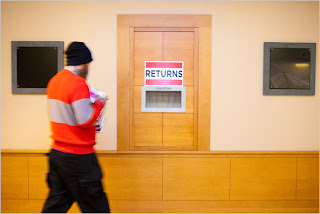
The Monterey County Free Library system in Monterey, Calif., has reclaimed more than 1,000 books since offering end-of-the-year amnesty to patrons in November and December.
“We thought, People are suffering, having a hard time, so let’s give them a break and get our books back,” said Jayanti Addleman, the county librarian.
In Pelham, N.H., the public library director, Robert Rice, offered a food-for-fines program during November.
“We will probably continue that policy once the new year starts,” Mr. Rice said. “The loss in terms of money was maybe $20 a day. We well made up for it with the amount of food that came in.”
He continued: “We got our materials back and did something positive for the community. Use is up greatly, and budgets are being cut. But we’re not going anywhere. We’re keeping the doors open.”
That is how libraries should work, as community resources, and not as businesses.

Since the beginning of the economic downturn, librarians across the country have speculated that fines for overdue items are keeping people from using the library — particularly large families whose children take out (and forget to return) many books at a time. Some libraries learned that the fines, which are often as low as 25 cents an item per day, quickly multiplied for many people and were becoming an added hardship.
“We can’t push the cost to consumers because they’re also struggling,” said Richard Sosa, the finance director of the Denver system, which has $9 million worth of books in circulation through 23 libraries and two bookmobiles. “The library philosophy is: We do not want to restrict access to information. The use of fines or harsh collection tactics — and we could potentially do that — could essentially restrict people’s access to the library.”
And another thing: They need their books back.
At the Denver Public Library, librarians can negotiate a fee structure that feels fair to them based on individual cases.

The Monterey County Free Library system in Monterey, Calif., has reclaimed more than 1,000 books since offering end-of-the-year amnesty to patrons in November and December.
“We thought, People are suffering, having a hard time, so let’s give them a break and get our books back,” said Jayanti Addleman, the county librarian.
In Pelham, N.H., the public library director, Robert Rice, offered a food-for-fines program during November.
“We will probably continue that policy once the new year starts,” Mr. Rice said. “The loss in terms of money was maybe $20 a day. We well made up for it with the amount of food that came in.”
He continued: “We got our materials back and did something positive for the community. Use is up greatly, and budgets are being cut. But we’re not going anywhere. We’re keeping the doors open.”
That is how libraries should work, as community resources, and not as businesses.
Tuesday, December 22, 2009
Public Library, Valladolid
 Visited afternoon of 3 December 2009, on way back from Cenote Zací. Quite small. So is Valladolid.
Monday, December 21, 2009
Lone Bookstore's Last Chapter

Fourth-graders at C. M. Macdonell Elementary School in Laredo who wrote letters trying to persuade their bookstore, the only one in town, not to close.

Mary Benavides steps from behind the cash register several times a day to embrace the mourners. For more than 30 years, she has managed the mall's B. Dalton outlet -- the only bookstore in Laredo. It will close next month.
slideshow
All B. Daltons nationwide are closing, as corporate parent Barnes & Noble shutters the chain. In this era of mega-bookstores with cafes and cozy couches and 150,000 titles -- and with more than a million books available online -- B. Dalton's cramped outlets no longer make economic sense.
Xavier Garcia and Joe Garcia IV read at the B. Dalton bookstore in Laredo, Texas.

The city council is expected to pass a resolution Monday proclaiming that Laredo needs a bookstore. State lawmakers have promised to write letters. A "Save Laredo's Bookstore" page on Facebook has 530 members and a city committee is circulating petitions. The theme of their campaign: Laredo Reads.
Now (Monday, 1.15pm) up to 6
Jose Angel, 10, stands in front of two boards with English and Spanish words in his bilingual class.

Author Sonia Nazario saw that first-hand when the bookstore manager and several high-school teachers invited her this fall to discuss her book "Enrique's Journey." Over two days, Ms. Nazario spoke to 4,000 people, and some waited hours for her autograph. "It was like the hottest rock star had shown up in town," she said. "I've never had such a reception in my life."

Nearly 2,000 copies of her book sold in Laredo, and there was a waiting list for all 75 copies at the public library.
"Books created a communal bond in what was, to me, an unlikely place," Ms. Nazario said. "The beating heart of that was the bookstore."
Thursday, December 17, 2009
Rarest of Rhinos

Ujung Kulon National Park Authority/WWF Indonesia
A male Javan rhinoceros, photographed by a trap camera in Ujung Kulon National Park in Indonesia. It is described as the rarest large mammal on earth.
A sixth grader came in, along with his grandfather, looking for an article that appeared in the New York Times on 11 July 2006. I showed them how to use the microfilm reader, and, when they found the article, how to print it.
Now that they have left I went onto the Times website, and, as I had told them was doable, found the article itself.
Wednesday, December 16, 2009
Magazines get ready for tablets
Sports Illustrated developed a demonstration version of how it might translate its print articles on a tablet computer. The tablet version can pull live sports scores and display videos and other interactive content.

 Video: Sports Illustrated's Tablet Demo (YouTube.com)
After letting the Internet slip away from them and watching electronic readers like the Kindle from Amazon develop without their input, publishers are trying again with Apple iPhones and, especially, tablet computers.
Although publishers have not exactly been on the cutting edge of technology, two magazines — Esquire and GQ — have developed iPhone versions, while Wired and Sports Illustrated have made mockups of tablet versions of their print editions, months before any such tablets come to market. Publishers are using the opportunity to fix their business model, too.
Tuesday, December 15, 2009
Lewy bodies
 A patron came in asking for books on Lewy bodies. Turns out they have to do with dementia and Alzheimer's. She had done research, and the websites directed her to books on the subject. She cam into the library after dropping off her husband at a center (he is the one suffering from them).
A new one to me. This is one of the books I found through FirstSearch (also can be found through Worldcat.org).
Lewy bodies are abnormal aggregates of protein that develop inside nerve cells.
Monday, December 14, 2009
Who owns e-books?
Random House Lays Claim to E-Book Rights
By Jeffrey A. Trachtenberg
Random House, moving to stake its claim in one of the few fast-growing areas of book publishing, sent a letter to literary agents saying it owns the digital rights to books it published before the emergence of an active marketplace for electronic books.
In the letter, dated Dec. 11, Markus Dohle, chief executive of the publishing arm of Bertelsmann AG, wrote that the "vast majority of our backlist contracts grant us the exclusive right to publish books in electronic formats." He added that many of Random House's older agreements granted it the exclusive right to publish a work "in book form" or "in any and all editions."
The letter addresses one of the most controversial issues in publishing these days: who owns digital rights to older titles, often referred to as backlist books.
Mr. Dohle argues that, much as the understanding of publishing rights has evolved to include various forms of hardcovers and paperbacks, it now includes digital rights, since "the product is used and experienced in the same manner, serves the same function, and satisfies the same fundamental urge to discover stories, ideas and information through the process of reading."
Nat Sobel, a literary agent whose clients include James Ellroy and Richard Russo, both of whom are published by Random House's Alfred Knopf imprint, disagreed with Mr. Dohle's assertions.
Mr. Sobel said that prior to the September publication of Mr. Ellroy's novel "Blood's a Rover," the third volume in the author's Underworld USA trilogy, he received a letter from Random House asking for the release of electronic rights associated with the trilogy. He said he ignored the request because he has other plans for those rights.
"I don't accept Random House's position, and I don't think anybody else will either," Mr. Sobel said. "You are entitled to the rights stated in your contract. Contracts 20 years ago didn't cover electronic rights. And the courts have already agreed with this position."
Stuart Applebaum, a spokesman for Random House, said, "We believe Random House has the right to publish our authors' backlist titles as e-books. We think we can do the best job for our authors' e-books."
Several years ago, Random House sued e-book publisher RosettaBooks LLC to prevent it from selling the e-book editions of three authors—William Styron, Kurt Vonnegut Jr. and Robert Parker—whose books had been published by Random House's imprints.
In 2001, in a key ruling, the U.S. District Court for the Southern District of New York denied a Random House petition for a preliminary injunction against RosettaBooks, ruling that Random House's contracts were limited to print books and didn't cover e-books. A federal court of appeals subsequently affirmed the district court's opinion.
In late 2002 Random House and RosettaBooks settled their litigation. As part of that settlement, Random House dropped its objection to RosettaBooks publishing the titles in question, and granted RosettaBooks the right to publish 51 additional titles. Those rights lasted between three and six years.
"At this point, all our Random House licenses have expired," said Arthur Klebanoff, CEO of RosettaBooks. "I am surprised by Mr. Dohle's letter. The last time Random House advanced the same position, it didn't work out so well for them. And I don't think it will work out so well for them now."
A second literary agent, Richard Curtis, who also owns E-Reads, an e-book publisher, said he would expect Random House to go to court to defend its new claims, as it once did.
"Someone would have to have a lot at stake to be willing to spend hundreds of thousands of dollars to go up against Random House in court," he said. "I don't know whether anybody will feel they want those rights so badly they are willing to spend like that to prosecute a claim right up to what could be the Supreme Court."
Saturday, December 12, 2009
End of an era and a name
End of Kirkus Reviews Brings Anguish and Relief
By Motoko Rich
Published: December 11, 2009 - NY Times
The book industry, beleaguered by a battery of dispiriting news about lackluster sales and online price wars, got another taste of the apocalypse on Thursday with the news that Kirkus Reviews, the venerable prepublication review journal, was closing.
Then again, there were those who were not so quietly relieved that a frequent source of author flaying had been subdued.
“When I was a book publicist, the worst part of my job was having to read a Kirkus review over the phone to an author. 2 cigs before, 2 after,” recalled Laura Zigman, an author and former book publicist for Alfred A. Knopf, in a Twitter post.
The decision by the journal’s owner, the Nielsen Company, to close Kirkus stunned the industry, with a reaction that was a mix of “Oh no!” “Good riddance” and “Ho hum.”
Founded in 1933, Kirkus churned out nearly 5,000 reviews a year. Although typically not seen by the general public — except in blurbs on books or excerpted on barnesandnoble.com — Kirkus reviews were often used by librarians and booksellers when deciding how to stock their shelves.
“None of us can read everything we suggest, so we lean fairly heavily on reviews and reviewers as basically our own advisers,” said David Wright, a fiction librarian and readers’ adviser for the Seattle Public Library.
Mr. Wright, who said he read reviews from Kirkus as well as its rivals Publishers Weekly, Booklist and Library Journal, said the reviewers for these publications “always really seemed like this gathering of friends and family that you could gather to get feedback on what really was in a book to see if a reader might like it.” He added, “Kirkus has always anchored that table.”
Booksellers gave mixed reviews about Kirkus’s influence. Some said they read it along with other journals, as well as talking with publishers’ sales representatives and reading advance galleys, when deciding what to buy. Others said they had long since stopped reading Kirkus.
Vivien Jennings, co-owner of Rainy Day Books, an independent bookstore in Fairway, Kan., said she sometimes consulted Kirkus Reviews when a customer inquired about a book that she had not read.
In one instance recently, a customer asked about “Everything Ravaged, Everything Burned,” a collection of short stories by Wells Tower that she wanted to buy as a gift. Ms. Jennings, who had actually read — but had not connected with — the book, looked up the Kirkus review.
“When I read the woman the review from Kirkus, she said, ‘That will exactly work for my husband,’ ” and she bought the book, Ms. Jennings recalled.
In some ways it seemed that the passing of Kirkus was mourned much like the local deli that finally closes after a long battle with a landlord — missed as much in theory as because of its practical effect on the market.
“While I hate to see the closing of another major book review outlet, truth be told, it’s been a long time since a review there actually moved the needle in any meaningful way,” wrote Tim Duggan, executive editor at Harper, an imprint of HarperCollins Publishers, in an e-mail message. “It has less to do with Kirkus than with the way the rest of the media marketplace has evolved.”
Still, some publishers noted that Kirkus reviews, reliably cantankerous, often differed from the other prepublication reviewers. “It wasn’t just broad, it was rigorous, curmudgeonly, and it was often a dissenting or idiosyncratic voice,” said Nan Graham, editor in chief of Scribner, an imprint of Simon & Schuster.
For small presses, Kirkus might be one of the only places a book would get a write-up, other than Publishers Weekly. Martin Shepard, co-publisher of the Permanent Press, an independent publisher in Sag Harbor, N.Y., said Kirkus had generally reviewed about 10 of the 12 to 14 books that the company publishes each year.
Because small presses rely heavily on sales to libraries, Mr. Shepard said, the loss of Kirkus is a significant blow. Although he said the most important trade journal remained Publishers Weekly, he said: “It’s like Hertz and Avis. To have the No. 2 close down is sad.”
Mr. Shepard said he was starting a campaign to persuade the editors of Kirkus to revive the publication online.
Eric Liebetrau, managing editor of Kirkus, declined to comment on the magazine’s closing.
Authors seemed to have a mixed relationship with Kirkus. Not surprisingly, it had to do with what the reviewers said about their books. Julie Klam, the author of a memoir, “Please Excuse My Daughter,” said her editor had told her that while a good review in Kirkus could help a little, “if you get a bad one, it doesn’t matter, because nobody reads it.”
A good could help, a bad didn't matter as nobody read it: then how could a good one help?
Ms. Klam, who received a good review in Kirkus, recalled seeing fellow writers get starred reviews — the highest honor — and being jealous. “They were so rare,” Ms. Klam said. “So you think, ‘Wow, that’s major.’ ”
Correction: December 12, 2009
An earlier version of this article misspelled the given name of a co-owner of Rainy Day Books. She is Vivien Jennings, not Vivienne.
Wednesday, November 25, 2009
Google to put Iraqi artifacts online
Eric Schmidt, the chief executive of Google, at the National Museum on Tuesday. Most of the collection is in secret storage.

Amira Edan, the director of Iraq’s National Museum, says that soon she will no longer have to worry so much that the famous institution remains closed to the public for fear of violence.
People will just be able to Google it. “It’s really wonderful,” she said Tuesday.
Eric Schmidt, the chief executive of Google, had just made a presentation inside the museum, announcing that his company would create a virtual copy of the museum’s collections at its own expense, and make images of four millenniums of archaeological treasures available online, free, by early next year.
For free.
The museum, badly looted during the American invasion, has been declared reopened three times: in 2003, by the American occupation authorities, again in 2007 by Iraqi officials and most recently in February by Prime Minister Nuri Kamal al-Maliki.
None of those openings, however, involved letting the public back in. A few invited scholars, journalists and the occasional school group have been allowed to visit. Only 8 of the museum’s 26 galleries have been restored; most of the collection’s treasures are in secret storage.
Part of the Bush-Cheney legacy: no planning whatsoever was done, leaving the museum, and more, open to looting and destruction.
What no one at the event mentioned was that the National Museum’s collections had already been digitized, at least in part, by Italy’s National Research Center, under a 1 million euro grant from the Italian Ministry of Foreign Affairs. The collections went online last June as the Virtual Museum of Iraq.
Tuesday, November 24, 2009
Pop-up king sprung books to life
Waldo Hunt, shown in 2002, holds up a copy of a pop-up book he produced, 'The Haunted House' by Jan Pienkowski.

Remembrances
November 24, 2009
Waldo Hunt: 1920-2009
The 'King of the Pop-Ups' Made Books Spring to Life
By Stephen Miller
An impresario of printed extravaganzas, Waldo Hunt led a renaissance of pop-up books.
Mr. Hunt, who died Nov. 7 at age 88, was a one-time advertising executive who developed a specialty in creating pop-up magazine inserts. But what started as eye-catching marketing for Wrigley's gum and Dodge pickup trucks grew into a literary subgenre.
Fascinated by what had become a lost art in the U.S. by the 1960s, Mr. Hunt built on his experience developing pop-up marketing materials into a focus on books. While not an artist himself, Mr. Hunt was adept at coordinating the complex process of assembling the books, from design to production and assembly. Leading publishing houses including Random House hired him to package pop-up titles for adults and children.
The companies he founded, Graphics International and Intervisual Books, produced hundreds of books, including some that were translated into more than a dozen languages. "King of the pop-ups" became Mr. Hunt's moniker in professional circles.
Mr. Hunt produced dozens of books for Walt Disney; a series based on Babar; and popular titles including "Haunted House" and "The Human Body." A 1967 pop-up published by Random House, "Andy Warhol's Index," came about at the suggestion of the artist. It combined celebrity photos with pop-up versions of signature Warhol touches like a cardboard can of tomato paste.
Babar. I read Babar to my kids.
"He single-handedly kept the torch of pop-up books alive from the 1960s through the 1990s," says Robert Sabuda, the best-selling creator of elaborate children's pop-up books. "Those of us who are in the newer generation of pop-up books would have no career without Wally Hunt."
Though pop-ups had flourished in Germany and Britain in the 19th century, and gained a following in the U.S. in the 1930s, they were little known in the post-World War II era.
"No one was doing pop-ups in this country," Mr. Hunt told the Los Angeles Times in 2002. "No one could afford to make them here."
Pop-up books allowed Mr. Hunt to combine his love of exuberant design with his overseas production contacts cultivated from his work in advertising. To save on labor costs, he had his early books assembled in Japan; production later moved to Singapore and to Latin America. Design was handled by a coterie of independent artists whom Mr. Hunt called "paper engineers" for their skill at unfurling three-dimensional figures from flat paper.
The son of a Unitarian minister and a music teacher, Mr. Hunt grew up in Salt Lake City and southern California, and served in the infantry during World War II.
After the war, he opened an advertising agency in Los Angeles, specializing in high-quality printed materials. He sold his first agency in 1956, and founded Graphics International Inc., to serve as a broker between Japanese printers and U.S. clients.
Mr. Hunt described his infatuation with pop-up books as a bolt from the blue. One day in the early 1960s while walking down New York's Fifth Avenue, he spotted a pop-up book in a shop window.
"I could look at that children's book from Czechoslovakia and see in it my answer," Mr. Hunt told the Los Angeles Times. "I knew I'd found the magic key."
After his bid to import a large number books by the book's Czech artist, Vojtech Kubasta, was thwarted by Communist authorities, Mr. Hunt turned to producing them himself. The first was a promotional volume produced in conjunction with Random House for Maxwell House Coffee, "Bennett Cerf's Pop-Up Riddle Book," which customers could receive by sending in two can labels and $1.
Bennett Cerf, Random House's top editor, put his son Christopher in charge of the project.
"You'd pull a tab and something funny would happen, and the answer to the riddle would be revealed," Christopher Cerf recalled in an interview. The younger Mr. Cerf and Mr. Hunt went on to produce about 30 more children's pop-up books for Random House, including volumes featuring Sesame Street characters. In his memoir "At Random," Bennett Cerf described the pop-up books as big money makers.
Mr. Hunt "was a joyful man," says Christopher Cerf. "Sometimes to his own detriment, he took on huge, crazy projects. Nothing was impossible."
Thursday, November 19, 2009
Help wanted: archivist
Must love the Dead. Must have MLS.
| The Daily Show With Jon Stewart | Mon - Thurs 11p / 10c | |||
| Want Ads - Grateful Dead Archivist | ||||
| ||||
Business Apps Offer Social Tools
Microsoft, Salesforce.com Take Networking-Site Cues
By Nick Wingfield And Ben Worthen (WSJ)
An unlikely software sector wants to get in on the social-networking act: business applications.
On Wednesday, Microsoft Corp. and Salesforce.com Inc. became two of the most high-profile companies yet to retool business-oriented offerings to emulate Facebook, Twitter and LinkedIn—Web services that help consumers track each other using posted photos, information feeds, status updates and other features.
Microsoft, of Redmond, Wash., said the next version of its Outlook e-mail program will automatically display personal information from social-networking sites for people in Outlook’s address book.
Meanwhile, Salesforce.com, a San Francisco-based company known for software it offers as a Web service, announced a set of enhancements called Chatter that mimic some of the functions of sites like Twitter and Facebook.
Smaller start-ups like Xobni Corp. also have found significant audiences by forming connections between social sites and business applications. The moves are the latest sign of how consumer-oriented technologies—from instant messaging to Apple Inc.’s iPhone—are invading the workplace and forcing companies to adapt to advances that boost productivity.
For example, social-networking sites help users track the identities and activities of others, which can come in handy in a big company. A lot of businesses have started to ask, “Why is it easier to follow strangers on Facebook than employees in my own company?” said Marc Benioff, Salesforce.com’s chief executive.
Salesforce.com says Chatter will allow employees to create profiles similar to the ones found on Facebook, albeit with an emphasis on connecting colleagues with relevant skills or projects. It is also designed to let users receive updates about data stored in the system. Mr. Benioff said Chatter, which should be available in early 2010, will be available for free to all Salesforce.com customers.
Microsoft says the next version of its e-mail software, Outlook 2010, will allow someone who receives an e-mail to quickly view a dossier of sorts on the sender by seeing a photo they have posted of themselves on social-networking sites and short messages about what they’re doing on Twitter and Facebook. The information will appear in a window within Outlook 2010, which went into public testing this week and will be released in final form during the first half of next year.
“It gives you a really nice, holistic view of things that you have in common with people on e-mail,” said Chris Capossela, a Microsoft senior vice president. “It gets you out of the e-mail-only silo and gives you a much more 360-degree view.”
Ellen Levy, vice president of corporate development and strategy at LinkedIn, said blending information from its service—such as employment and education history—with Outlook could help people form stronger professional bonds with people they’re communicating with through e-mail.
Yet there’s also the potential for complicating business relationships too. People who express overtly political opinions on Facebook or Twitter or share stories of personal traumas might find those details coloring their dealings with business associates.
Charlene Li, an analyst at Altimeter Group who follows social media, doesn’t believe that there’s a privacy dilemma created by business applications tapping into social-networking sites since, in most cases, people have already made a calculation about what information—and with whom—they’re comfortable sharing online.
e-Wired
Article in today's Journal
Condé Preparing E-Reader Version of Wired
by Russell Adams
Condé Nast Publications Inc. and Adobe Systems Inc. are building a digital version of Condé Nast’s Wired magazine for electronic reading devices.
Makes logical sense that people reading the magazine would like it to be electronic.
The Wired e-reader application will be available by the middle of next year and will kick off similar efforts across Condé Nast’s magazines, which include Vogue, Vanity Fair and the New Yorker. Condé Nast declined to say how much money it was spending on the effort.
Publishers have struggled to render magazines on mobile devices. That is partly because most existing e-readers don’t allow for color or many of the design elements deemed necessary to sell ads and incorporate key features of the magazine-reading experience. Condé Nast executives said they expect that by the time the Wired product is ready, e-readers will have access to a new generation of hardware capable of supporting it.
Magazine reading experience. I always thought it was simply reading.
As with many existing Web and mobile editions of magazines, the Wired application will let readers “flip” through the pages of the magazine as it appears in print. Readers will be able to zoom and pan on images, launch videos and link to the Web, as well as sync the application to their smart phones.
Unlike with existing products, Wired editor Chris Anderson said, the next wave of e-readers and platforms like Adobe’s will incorporate the rich design and “lean-back elements” that are among magazines’ chief strengths.
Condé Nast, a unit of Advance Publications Inc., has moved more slowly than some of its peers in pushing its magazines beyond print. Now it is putting a heavy emphasis on its digital business at a time when its print business has come under great strain. The publisher this year has laid off hundreds of employees and closed a handful of magazines.
Subscribe to:
Posts (Atom)

