From the ALA weekly newsletter, an interesting article: Professor teaches librarians to never be meek. CeEarly on, professor Toni Samek asks her students this question: Is homelessness a library issue?
Students entering the Master of Library and Information Studies program at the University of Alberta, where Samek has taught for 18 years, come from fields as diverse as nursing and law. They arrive not knowing what to expect. But after the homelessness question, students forget their stereotypes about meek librarians. Samek is anything but meek. In fact, she sees herself as an activist in a radical profession. It’s no surprise, then, that her teaching is grounded in the idea put forward by scholar Henry Giroux that a good education is one that is constantly engaged with public life.
Giroux is a new name for me.
Giroux has been an important contributor to a variety of academic fields, including critical pedagogy, cultural studies, youth studies, and media studies, among others. His work draws from a number of theoretical traditions extending from Marx to Paulo Freire to Zygmunt Bauman. He is also an advocate of radical democracy, vigorously opposing the anti-democratic tendencies of neoliberalism, militarism, empire, religious fundamentalism, and the ongoing attacks against the social state, the social wage, youth, the poor, and public and higher education. Giroux's most recent work focuses on public pedagogy, a term he coined to describe the nature of the spectacle and the new media, and the political and educational force of global culture. He is also a regular columnist for Truthout and writes for a variety of academic journals and public venues.
Showing posts with label Social conditions. Show all posts
Showing posts with label Social conditions. Show all posts
Wednesday, February 29, 2012

Wednesday, July 22, 2009
Target Can Make Sleepy Titles Into Best Sellers
At Target, Bookmarked book club titles get stickers, left, and special shelves, above. Almost one-third of the sales of “Still Alice,” by Lisa Genova, can be traced to Target.

When “Sarah’s Key,” a novel about an American journalist investigating the 1942 roundup of Jews in Paris, was published in hardcover two years ago, it dropped with a thud. According to Nielsen BookScan, which tracks about 70 percent of sales, the book sold just 2,000 copies.
Indeed, the book, by the first-time novelist Tatiana de Rosnay, was well on its way to sinking out of sight last fall when Target, the discount retailer, chose the paperback version of “Sarah’s Key” as its Bookmarked Club Pick: a choice for a program that designates titles for prominent display throughout the chain’s stores. Suddenly sales exploded.

In publishing circles Target has long been known as a place that can move many copies of discounted best sellers, as do other mass-merchant retailers like Wal-Mart and Costco. But in the last few years, much in the way it has cultivated its image as a counterintuitive purveyor of Isaac Mizrahi clothes or Michael Graves tea kettles, Target has been building itself into a tastemaker for books.
Through its book club, as well as a program it calls Bookmarked Breakout, both started in 2005, the company has highlighted largely unknown writers, helping their books find their way into shopping carts filled with paper towels, cereal and shampoo.
Target “can sell hundreds of thousands of copies of a book that is virtually unknown in the rest of the marketplace,” said Jacqueline Updike, director of adult sales at Random House, one of the world’s largest publishers.
By assembling a collection of books by unheralded authors, Target behaves more like an independent bookstore than like a mere retailer of mainstream must-haves (although, of course, Target sells its share of best-seller list regulars, like James Patterson and Janet Evanovich).
Target began its Bookmarked Club Pick and Breakout programs partly to convert “Target core guests into regular Target book shoppers,” said Jana O’Leary, a spokeswoman, in e-mailed responses to questions. Ms. O’Leary said that Target’s “core” book buyers were women, with a median age of 42 and median annual household income of $60,000. About half have completed college degrees, and some have children at home.
The books for both programs are chosen by a panel of Target employees who meet monthly to review submissions from publishers.
In a letter written for the Target edition of “The Wednesday Sisters,” Ms. Clayton connected Target with her main characters: “As women with relationships and jobs to tend to, dinners to cook, miles to run, and children to raise, where else would they go for sweatshirts, cookie pans and the alarm clocks that wake them up so they can write in the early-morning silence, before life intrudes?”
In an interview Ms. Clayton said she was more likely to go to Target herself for “teapots and toasters” and mainly bought books at local independents. Target, she figured, would expand the more typical audience for her novel. “Your book is being seen by people who aren’t necessarily there to buy books,” she said. “It makes you think that walk-by traffic is still selling books.”
Ms. de Rosnay, the author of “Sarah’s Key,” who lives in France, said she knew her paperback had a chance of much bigger sales when a friend sent her an iPhone photo of a shelf full of copies of her book at a Target. “That’s when I realized this was big — really big,” Ms. de Rosnay said.
Saturday, February 7, 2009
Mean Streets
Home buyers signed a statement saying they would 'not permit the premises to be used or occupied by any person other than members of the Caucasian race.'
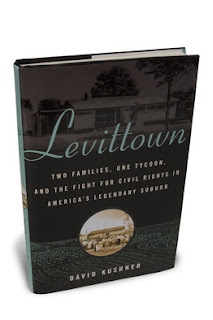
In "Levittown," a vigorous and often surprising narrative, David Kushner journeys into the racially charged heart of what newspapers once trumpeted as "the most perfectly planned community in America." Today Levittown serves as condescending shorthand for suburban conformity. But just after World War II, Levittown, N.Y., and its sister community of Levittown, Pa., symbolized liberation from crowded urban neighborhoods for families whose idea of the American dream was a private home and a patch of grass.
Both Levittowns were conceived from the start as complete communities, themselves prefabricated, so to speak, with shopping centers, churches, pools, parks, curved streets for a rural feel and cul-de-sacs where children could play safely. The Levittown customer, declared Bill Levitt, was "not just buying a house, he's buying a way of life." By 1952, the Levitts were building one out of every eight homes in the country. Time magazine dubbed their company the "General Motors of the housing industry."
But there was a snake in paradise: racial segregation. Buyers of Levittown homes were required to sign a statement that declared, in bold capital letters, that they would "not permit the premises to be used or occupied by any person other than members of the Caucasian race." Like many developers, the Levitts believed that racial integration was commercial suicide.
Mr. Kushner suggests that the demand for housing in the years after the war was so great that the Levitts could have integrated their towns from the start and thus set a national pattern. Instead they capitulated to what they perceived to be Americans' darkest fears. "The plain fact is that most whites prefer not to live in mixed communities," Bill Levitt repeatedly declared.
The core of Mr. Kushner's story focuses on the campaign to desegregate Levittown, Pa., in 1957. He deftly splices together the experiences of two families at the center of what became a terrifying ordeal. Bill and Daisy Myers and their children were educated, friendly, quiet people – just the sort of folks anyone would want to have next-door – except that they were black. Their staunchest local allies were Bea and Lew Wechsler, labor organizers and longtime members of the Communist Party. The Wechslers were among the few whites who remained uncowed by the venomous racism that gripped Levittown that summer.
With the support of local Quakers and the NAACP, the Myerses moved into their Cape Cod-style "dream house" on Deepgreen Lane. They got more than they bargained for. Crosses were burned. Mobs waving Confederate flags staked out their home night and day. Rocks were thrown through their windows. Malicious callers rang their phone around the clock: "I will not let my children drink chocolate milk again as long as I live!" one irate woman yelled at Daisy Myers. Threats were made to burn them out. The local authorities refused to intervene. The police, for the most part, claimed that they were helpless to control the mobs. Many residents in fact blamed the Myerses for provoking all the "agitation."
Subscribe to:
Posts (Atom)

